
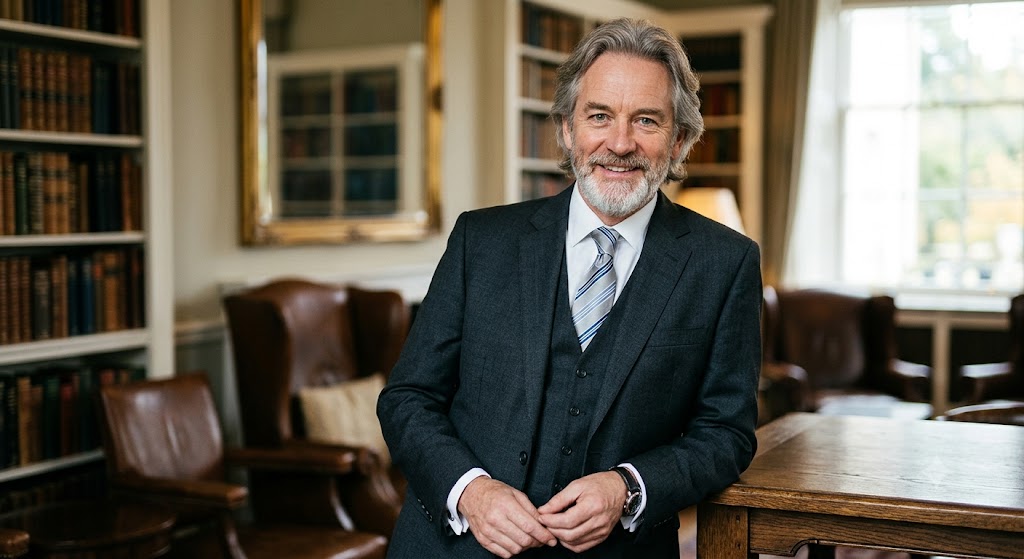
Richard Lintern is one of those actors audiences often recognise before they remember his name. With a career spanning British television, feature films, major theatre productions, documentary narration and video-game voice acting, he has built an unusually varied body of work without relying on celebrity-driven publicity.
He is best known to mainstream television viewers as Dr Thomas Chamberlain in the BBC forensic drama Silent Witness. His wider résumé, however, includes The Crown, The Shadow Line, Spies of Warsaw, The Bank Job, Jinnah, Clybourne Park and the Elden Ring: Shadow of the Erdtree expansion. His professional agency also lists recent roles in Robin Hood, The Deal, Dalgliesh, Nolly, Best Interests and The Reckoning.
Who Is Richard Lintern?
The actor Richard Lintern is an English stage, television, film and voice actor from Taunton, Somerset. He studied English literature at Durham University followed by professional training at the Royal Academy of Dramatic Art, also known as RADA.
According to RADA, he graduated from the academy’s acting diploma in 1987. It appears that he continued his professional development in theatre, television, and cinema rather than focusing his energy on one particular franchise.
His acting career was characterized by its incredible variety of roles he played. For instance, he portrayed doctors, lawyers, clergymen, spys, policemen, aristocrats, and historical characters, as well as evil overlords.
Richard Lintern at a Glance
- Profession: Stage, television, film and voice actor
- Birthplace: Taunton, Somerset, England
- Birth year: Commonly reported as 1962
- Education: English literature at Durham University
- Drama training: RADA acting diploma, graduating in 1987
- Best-known television role: Dr Thomas Chamberlain in Silent Witness
- Notable films: Jinnah, Syriana, Cassandra’s Dream and The Bank Job
- Notable theatre work: Clybourne Park, Blue/Orange, Jumpy and Women Beware Women
- Video-game role: Igon in Elden Ring: Shadow of the Erdtree
- Recent television credit: The Bishop of Hereford in MGM+’s Robin Hood
A Fact-Checking Note About His Date of Birth
Several entertainment databases publish conflicting dates for the actor’s birthday. One source gives 8 October 1962, another lists 25 October, while some streaming profiles have published a September date.
Because his RADA and agency profiles do not provide a precise birthday, the most responsible biographical wording is that he was born in Taunton in 1962. Sites publishing an exact age or birthday should acknowledge the inconsistency rather than presenting one secondary database as unquestionable fact.
Richard Lintern’s Early Life and Acting Education
Growing up in Somerset, Lintern did not initially follow a narrowly vocational acting route. Studying English literature gave him a foundation in language, narrative and dramatic texts before he pursued formal performance training.
He later received professional instruction at RADA, one of Britain’s best-known drama schools. His 1987 graduation places the beginning of his professional career in the late 1980s, when he started accumulating stage and television credits.
That combination of literary study and classical actor training helps explain the shape of his later work. His résumé repeatedly moves between contemporary drama, period productions, literary adaptations, crime series and historically rooted characters.
Building a Career in British Television
Before becoming a regular face on Silent Witness, Lintern appeared across a broad cross-section of British television. His agency résumé includes The House of Eliott, Heartbeat, Casualty, The Bill, Taggart, Cadfael, Poirot, Lewis, Midsomer Murders and The Inspector Lynley Mysteries.
These were not all interchangeable guest appearances. They allowed him to work across period drama, police procedurals, detective mysteries, medical programmes and character-led miniseries.
Later credits added more politically and psychologically complex material. He played DCS Richard Patterson in Hugo Blick’s The Shadow Line, Hector Stokes in Hunted, Colonel Lessard in Spies of Warsaw and Miles in the generational drama White Heat.
Why He Is Frequently Cast as an Authority Figure
A clear pattern emerges from Lintern’s television work. Casting directors repeatedly place him in roles associated with expertise, status or institutional power—pathologists, senior police officers, judges, lawyers, bishops and intelligence figures.
That observation is an interpretation of his documented credits rather than a claim about deliberate typecasting. Still, the pattern is hard to miss: Dr Thomas Chamberlain, Judge Holmgren, Anthony Arlidge QC, Tim Roberts QC, Colonel Lessard, DCS Patterson and the Bishop of Hereford all occupy positions of formal authority.
His restrained delivery makes those characters credible without requiring constant theatrical display. He can appear reassuring, intimidating or morally uncertain while maintaining the same controlled surface.
Richard Lintern in Silent Witness
The role that brought Richard Lintern his widest continuing television recognition was Dr Thomas Chamberlain, the head of the Lyell Centre in Silent Witness. He joined the forensic crime drama in its seventeenth series and remained part of the central team through series 23.
Chamberlain was introduced as an experienced forensic pathologist with particular knowledge of toxicology. He entered an established ensemble featuring Nikki Alexander, Jack Hodgson and Clarissa Mullery, gradually becoming a stabilising presence inside the Lyell Centre.
The character worked because he was not presented as an infallible television genius. Chamberlain could be socially perceptive and professionally confident, but he also had personal vulnerabilities and occasionally struggled with the expectations placed on the centre’s leader.
How Thomas Chamberlain Left Silent Witness
Spoiler warning: Chamberlain died in the series 23 finale after exposure to a nerve agent during an investigation. The episode aired in February 2020 and generated a strong reaction because the character had been a regular member of the programme’s forensic team since 2014.
The storyline ended Lintern’s seven-series run rather than leaving the door visibly open for an ordinary return. Public reporting confirms the character’s fate, but there is no sufficiently authoritative, widely available statement proving that the actor left because of a dispute, dismissal or specific personal reason.
That distinction matters. Many entertainment pages turn an unexplained casting departure into speculation. The confirmed fact is that the writers killed off Thomas Chamberlain; the private reasoning behind the production decision has not been clearly established in the reviewed primary materials.
Richard Lintern’s Film Roles
Although British television represents the largest part of his public profile, Richard Lintern has appeared in a varied selection of feature films. One of his most historically significant roles was the younger Muhammad Ali Jinnah in Jamil Dehlavi’s 1998 film Jinnah.
His other film credits include:
- Lost Souls as Graham Scofield
- The Calling as Marc St. Clair
- The Gospel of John as a leading Pharisee
- Syriana as Bryan’s boss
- Cassandra’s Dream as a director
- The Bank Job as Tim Everett
- Unmade Beds as Anthony Hemmings
- Jimi: All Is by My Side as Mr Keith
- The Love Punch as a film director
His part in The Bank Job is particularly representative of his screen persona. Playing an intelligence-linked official suited his ability to communicate control, concealed knowledge and institutional pressure with minimal exposition.
The film work also demonstrates that he was never limited to television crime dramas. His credits range from geopolitical thrillers and historical biography to religious drama, comedy and independent cinema.
Richard Lintern’s Theatre Career
Richard Lintern is not simply a television performer who occasionally appears on stage. Theatre has been a central part of his professional development, with work at the National Theatre, Royal Shakespeare Company, Royal Court, Young Vic, Old Vic, Hampstead Theatre, Birmingham Repertory Theatre and Park Theatre.
His recorded stage credits include:
- Russ and Dan in Clybourne Park
- Robert in Blue/Orange
- Roland in Jumpy
- The Duke of Florence in Women Beware Women
- Tony in Dial M for Murder
- Henry in The Real Thing
- George Kittredge in The Philadelphia Story
- Antonio in The Duchess of Malfi
- Horatio in Hamlet
- John in My Night with Reg
Theatre criticism offers useful evidence of his range. A review of Women Beware Women described his Duke as a forceful, sexually threatening presence, while coverage of Jumpy highlighted the neurotic quality of his suitor character. In Clybourne Park, his performance as Russ helped preserve the grieving character’s humanity within a sharp satire about racism, property and liberal self-deception.
Those roles are dramatically different. Together, they show an actor capable of moving from classical menace to contemporary discomfort, grief, comedy and social satire.
Voice-Over, Documentary Narration and Elden Ring
A significant but sometimes overlooked part of Lintern’s career is his work as a narrator and voice performer. His official résumé identifies him as the narrator of Nazi Mega Weapons, while broader credit records connect him with additional factual and historical programming.
Voice work uses many of the same qualities that define his screen performances: precision, authority, clear diction and the ability to suggest urgency without losing control.
In 2024, he reached an entirely new audience by voicing Igon in Elden Ring: Shadow of the Erdtree. The wounded warrior became memorable for his furious obsession with the dragon Bayle and for an intensely delivered battle monologue that spread rapidly through gaming communities.
The performance was striking because it departed from the quiet authority associated with many of his television roles. Igon is explosive, agonised and operatic—a reminder that Lintern’s controlled screen manner reflects character choices rather than a limited emotional range.
Recent and Current Career Activity
Richard Lintern has continued to work steadily beyond his departure from Silent Witness. His later credits include Young Wallander, Professor T, Death in Paradise, Dalgliesh, Best Interests, Nolly, The Reckoning and the Scandinavian crime production Cell 8.
His agency résumé also lists him as Gene Cory in The Deal. Because agency CVs may include projects at different stages of production or release, publication dates should be checked separately before describing a title as newly released.
In 2025, he appeared as the Bishop of Hereford in MGM+’s reimagining of Robin Hood. Casting coverage characterised the bishop as a politically powerful and calculating church figure, placing Lintern once again in the role of an influential man whose polished authority conceals self-interest.
What Makes Richard Lintern’s Acting Style Distinctive?
Several qualities recur throughout his work:
- Controlled vocal delivery: He rarely needs to shout to establish authority.
- Intellectual credibility: He appears comfortable with technical, legal, political and historical dialogue.
- Moral ambiguity: His characters often seem respectable before their motives become fully visible.
- Ensemble discipline: He supports long-form casts without pulling attention away from the central story.
- Cross-medium adaptability: His work translates effectively between intimate television acting, theatre projection, narration and heightened fantasy voice performance.
This analysis is supported by the unusually consistent character pattern in his professional résumé and the contrasting theatrical and voice roles documented across reviews and credit records.
His performances are often built through small choices—a pause, a measured response, a shift in vocal pressure or an expression suggesting that a character knows more than he is willing to disclose. That makes him particularly effective in mystery series, political thrillers and institutional dramas.
Richard Lintern’s Private Life
Lintern maintains a noticeably lower public profile than many actors with comparable television experience. His official agency and RADA pages concentrate on training and professional credits rather than publishing details about his spouse, home life or finances.
Some secondary biographies state that he is married and has three sons, but reliable primary sources do not publicly identify his wife. Responsible profiles should therefore avoid repeating unverified names, invented relationship histories or unsupported claims about his family.
The same caution applies to supposed net-worth figures. No audited financial information supports the precise estimates circulated by celebrity biography sites, so such numbers should not be treated as established facts.
Frequently Asked Questions
What is Richard Lintern best known for?
He is best known for playing Dr Thomas Chamberlain in Silent Witness from series 17 through series 23. The character served as head of the Lyell Centre and became a core member of the forensic team before his dramatic departure in 2020.
Why did Richard Lintern leave Silent Witness?
The confirmed on-screen explanation is that Thomas Chamberlain died after being exposed to a nerve agent. There is no clearly sourced public statement establishing that Lintern left because of a disagreement, health problem or dismissal, so claims about his private reason for leaving should be treated as speculation.
Was Richard Lintern in Elden Ring?
Yes. He voiced Igon in the 2024 Shadow of the Erdtree expansion for Elden Ring. The highly emotional performance introduced him to a large international gaming audience and became one of the expansion’s most widely discussed character voices.
What films and television programmes has he appeared in?
His credits include Jinnah, Syriana, The Bank Job, Cassandra’s Dream, The Crown, The Shadow Line, Spies of Warsaw, Hunted, White House Farm, Nolly, Dalgliesh, The Reckoning, Death in Paradise and Robin Hood. His career also includes numerous detective dramas, literary adaptations and theatre productions.
Who is Richard Lintern married to?
He keeps his family life private, and his official professional profiles do not identify his spouse. Although secondary sources commonly report that he is married and has children, no spouse name should be presented as verified without a reliable first-hand or primary source.
Conclusion: An Actor Defined by Range Rather Than Celebrity
Richard Lintern has built a durable career by becoming the kind of performer complex productions depend on. He can lead a forensic team, unsettle an audience as a corrupt authority figure, support a political thriller, command a classical stage or transform into a raging fantasy warrior using only his voice.
For viewers discovering him through Silent Witness, the best next step is to explore The Shadow Line, Spies of Warsaw, The Bank Job and The Crown. Theatre enthusiasts should look into his work in Clybourne Park, Jumpy and Women Beware Women, while gaming audiences can experience an entirely different side of his talent through Igon in Shadow of the Erdtree.