
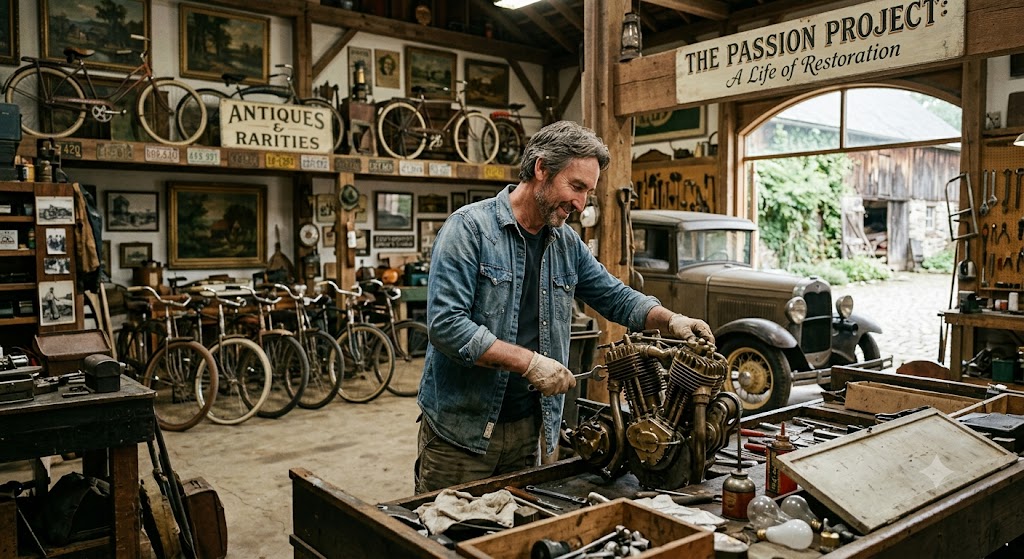
The Mike Wolfe passion project is best understood as a historic-preservation effort centered on Columbia, Tennessee, rather than one officially branded initiative. The phrase most commonly refers to Wolfe’s restoration of a neglected Esso service station into a community gathering place, but it also connects with his wider network of adaptive-reuse projects, including Columbia Motor Alley and Two Lanes Guesthouse.
That distinction matters. Numerous online articles describe a mysterious “passion project” without explaining what Wolfe has actually created. The verified story is more specific—and far more interesting.
The creator and longtime star of American Pickers is applying the same instinct he uses with antiques to neglected buildings, transportation landmarks, and small-town commercial districts. HISTORY describes Wolfe as a lifelong picker who recognizes value in forgotten objects and the stories attached to them; his property projects extend that philosophy from individual artifacts to entire places.
What Is the Mike Wolfe Passion Project?
In its narrowest sense, the Mike Wolfe passion project refers to the restoration of a mid-century Esso service station in downtown Columbia, Tennessee. Wolfe revealed the completed outdoor transformation in May 2025, explaining that he wanted to turn an ignored property into a place the community could enjoy for years.
The renovated site includes outdoor seating, lighting, landscaping, a fire pit, vintage service-station details, and space for social events. Wolfe also revealed that a tenant was building out a food-and-cocktail concept called Revival.
In a broader sense, the term covers Wolfe’s continuing effort to save old structures by giving them useful modern purposes. His projects combine:
- Historic building restoration
- Transportation history
- Vintage vehicle culture
- Adaptive reuse
- Heritage tourism
- Community-oriented events
- Hospitality and local business development
The project is therefore not simply about decorating an old gas station. It is an example of adaptive reuse: retaining the character of a historic structure while making it active, economically useful, and accessible again.
Mike Wolfe Passion Project Quick Facts
- Primary location: Downtown Columbia, Tennessee
- Best-known property: A restored mid-century Esso service station
- Hospitality concept: Revival
- Core purpose: Preservation, community gathering and heritage tourism
- Related properties: Columbia Motor Alley and Two Lanes Guesthouse
- Central philosophy: Save the structure, preserve its story and create a reason for people to return
Mike Wolfe Passion Project Timeline
The Mike Wolfe passion project evolved over several years rather than appearing as a finished celebrity business overnight. Understanding that timeline helps explain why older reports describe the property as a restaurant, outdoor courtyard, event space or wine bar.
- 2022: Reporting based on local property records indicated that Wolfe acquired the former wine-bar property containing the Esso station.
- 2023: Wolfe began publicly sharing his vision for restoring the service station and creating an intimate courtyard in Columbia’s historic district.
- 2024: Construction, permit work and inspections continued, while the outdoor pergola, fire pit, landscaping and seating areas took shape.
- May 2025: Wolfe shared a detailed reveal of the transformed property and said a tenant was developing Revival as a food-and-cocktail destination.
Updates surrounding the Mike Wolfe passion project sometimes appeared contradictory because the intended operating model changed during development. Early restaurant ideas gradually evolved toward a drinks-led social venue with food, events and shared outdoor space.
Rather than proving that the project lacked direction, those changes demonstrate how adaptive-reuse properties often develop. The building is preserved first; the most practical tenant, operating model and customer experience are refined afterward.
The phased development of the Mike Wolfe passion project is therefore an important part of the story. It was always a preservation project, even while the final hospitality concept continued to evolve.
Why the Old Esso Station Became the Center of Attention
The station drew the attention of the public, as it represents a type of roadside architecture that has been forgotten in America. Small gas stations used to serve as a link between drivers, mechanics, neighbors, and the booming culture of automobile travel.
In these places, their functions were lost, they were dismantled, or completely transformed. Wolfe saw another future for such a station.
As per the latest press release, he was looking for companies that could share his vision and help revive the gas station. The founder of Living EXO even noted that his company managed to take Wolfe’s idea and turn it into an outdoor space that would provide long-term value to the community.
The Mike Wolfe passion project not only saved the structure but also restored its signs, gas pumps, and overall appearance. Thus, the architecture of the building, its red and white color scheme, gas pumps, compact size, and roadside charm factors contribute to the preservation of its look.
What Was Added to the Esso Station?
Later on, the company shared with its followers all the useful improvements that had been made. The list included:
A wooden pergola that serves as the restaurant’s primary seating area;
A central fire pit with permanently arranged seating;
Outdoor tables and chairs;
String lighting for evening hours;
Pavers, planters, shrubs, and courtyard trees;
Restored gas pumps and vintage signs;
An area designed to host music and other performances;
Versatile space for hosting banquets, dinners, cocktails, and other events.
These improvements have made the place popular among people. In fact, the passion project of Mike Wolfe not only saved the gas station from being destroyed but also gave it a new look and completely transformed its functions. While before it was a gas station, now it is a place where people have to stop, sit, enjoy the atmosphere, and spend time together.
Is the Mike Wolfe Passion Project Called Revival?
Revival is the name associated with the hospitality concept planned for the restored station. It should not, however, be treated as the official name of every preservation initiative Wolfe has undertaken.
In May 2025, Wolfe stated that a tenant was building out Revival and that the venue would offer food and cocktails. At the time of that announcement, no official opening date had been published.
Other reporting described Revival as a potential wine bar and noted the installation of a rooftop neon sign designed to resemble historic signage associated with the property. The proposed operating format changed during development, moving from earlier restaurant plans toward a more flexible drinks, food and gathering concept.
The most accurate explanation is therefore:
The Mike Wolfe passion project restored the historic Esso station and courtyard, while Revival is the hospitality concept connected with the property’s next use.
Publicly indexed sources do not provide a sufficiently clear official confirmation of Revival’s 2026 hours or operating schedule. Travelers should verify current information through the venue, neighboring businesses or Columbia’s official tourism channels before planning a visit.
Columbia Motor Alley: The Larger Vision in One Building
The Mike Wolfe passion project becomes easier to understand when viewed alongside Columbia Motor Alley.
Wolfe’s official website describes Motor Alley as a restored 1947 Chevrolet dealership where his love of transportation history and historic preservation meet. The site explicitly calls it a passion project intended to inspire people to imagine what forgotten dealerships, service garages and gas stations could become.
This provides the clearest primary-source explanation of Wolfe’s larger mission. He is not preserving buildings simply because they are old. He is particularly interested in properties that once supported American transportation and movement, including:
- Automobile dealerships
- Motorcycle shops
- Repair garages
- Gas stations
- Manufacturing buildings
- Roadside commercial properties
These were the original environments for the signs, vehicles, tools, pumps and advertising pieces Wolfe has spent decades collecting.
More Than a Vintage Vehicle Display
Columbia Motor Alley adds recurring activity to the preservation model. Visitors can encounter vintage automobiles, motorcycles, memorabilia and merchandise in a building directly connected to automotive history.
Visit Columbia also listed Cars & Coffee gatherings hosted at Columbia Motor Alley on third Saturdays between April and October. That programming illustrates how a restored building can become a functioning social destination rather than a sealed historical artifact. Event schedules may change, so current dates should always be checked before visiting.
Two Lanes Guesthouse and Heritage Tourism
Another important branch of the Mike Wolfe passion project is Two Lanes Guesthouse, an approximately 1,100-square-foot, one-bedroom loft in downtown Columbia.
Wolfe designed the accommodation using objects gathered during his travels, including pieces associated with American Pickers. Instead of presenting the collection in a traditional museum environment, he placed it inside an immersive hospitality experience.
Guests can live among rescued Americana, vintage artwork, Western-inspired objects and transportation memorabilia. That creates a stronger emotional connection than simply viewing the same items behind glass.
The guesthouse also connects preservation with local economic activity. Visitors who stay overnight may:
- Eat at independent restaurants
- Shop at downtown stores
- Attend local events
- Explore nearby historic properties
- Extend what might otherwise be a short day trip
- Spend money across several locally operated businesses
Wolfe has said that he wants guests to leave with a greater appreciation for American Main Streets and an understanding of why those places deserve support. His official website also explains that Columbia’s transportation history first attracted him to the town and that its values reminded him of the Midwestern community where he grew up.
The Preservation Philosophy Behind the Mike Wolfe Passion Project
The strongest element of the Mike Wolfe passion project is its repeatable preservation philosophy.
Wolfe explained his process in detail while discussing an earlier Nashville building restoration. He begins by investigating the structure’s original purpose, historical period and relationship with the surrounding community.
He then looks for ways to retain original materials while adapting the interior for a commercially viable present-day use.
That approach can be divided into four major principles.
1. Start With the Building’s Story
Wolfe treats history as design information.
A former automobile dealership should not emerge from renovation looking like a generic retail unit. A service station should retain recognizable clues explaining why it was built and how people originally used it.
Researching the property first can influence:
- Materials
- Signage
- Interior layout
- Exterior restoration
- Merchandise
- Event programming
- Marketing language
- Tenant selection
The history is not added after construction. It guides the construction.
2. Preserve Recognizable Materials
During Wolfe’s Nashville project, saving original brick was a stated priority because the masonry carried more than a century of the building’s history. The same principle appears in Columbia through period pumps, automotive objects, signage and the recognizable profile of the Esso station.
Preservation does not always require freezing every feature in time. It means identifying which materials and characteristics make the structure distinctive and retaining enough of them to keep the story understandable.
3. Give the Building a Working Future
A restored property without a sustainable purpose can eventually return to vacancy.
The Mike Wolfe passion project connects historical character with practical uses such as:
- Retail
- Hospitality
- Food and beverages
- Short-term lodging
- Vehicle gatherings
- Private events
- Tourism experiences
- Community programming
This balance is crucial. Historic character attracts attention, but useful space keeps the building maintained and occupied.
4. Create an Experience, Not Just a Display
A fire pit encourages conversation. Cars & Coffee produces recurring foot traffic. A guesthouse allows people to experience rescued objects in a personal environment.
These features are not decorative extras. They are the operational layer that transforms preservation into social activity.
Why Did Mike Wolfe Choose Columbia, Tennessee?
Columbia provides an effective environment for this strategy because its downtown supports a combination of historic architecture, independent restaurants, shops, events and boutique lodging.
The city’s tourism organization describes downtown Columbia as a place where historical character meets a growing collection of contemporary local businesses. Events such as First Fridays help bring residents and visitors into the central commercial district.
For the Mike Wolfe passion project, that surrounding ecosystem is essential.
A restored gas station becomes more valuable when visitors can walk to another restaurant, enter a nearby shop, attend a downtown event or stay overnight. A single renovated building cannot create a complete destination by itself.
This also explains why Wolfe’s Columbia projects operate as a cluster. Columbia Motor Alley, Two Lanes Guesthouse, the Esso station and nearby commercial activity reinforce one another, creating a compact heritage-tourism circuit.
Community Impact: The Opportunity and the Tension
The potential benefits of Wolfe’s work are relatively clear. Restored properties can improve the streetscape, attract visitors, preserve recognizable landmarks and create commercial spaces that would otherwise remain vacant.
The Mike Wolfe passion project also introduces Columbia to Wolfe’s national television and social-media audience. That exposure can encourage:
- Weekend road trips
- Downtown event attendance
- Overnight stays
- Restaurant visits
- Shopping at local businesses
- Interest in transportation history
- Investment in additional old properties
However, responsible analysis should not assume that every resident supports every redevelopment decision. Entertainment reporting has described mixed reactions to Columbia’s changing commercial landscape, although much of that coverage relies on unnamed sources and should not be interpreted as a comprehensive measurement of local opinion.
The larger lesson is that preservation works best when it remains connected to local needs. An attractive renovation may protect a building’s memory, but long-term success also depends on compatible tenants, reasonable access, thoughtful operations and participation from the surrounding community.
What Makes It Different From a Typical Celebrity Business?
A conventional celebrity restaurant, bar or retail store often depends primarily on the public figure’s name. The Mike Wolfe passion project works differently because the historical property existed before the final business model was determined.
The building came first.
Its architecture, former purpose and transportation identity influenced the design. The hospitality concept was then fitted into that framework rather than using an unrelated historical building as a superficial backdrop.
That process mirrors Wolfe’s television persona. American Pickers is based on finding value in neglected objects, researching their origins and connecting them with people who can preserve or reuse them.
His Columbia projects apply the same pattern at an architectural scale:
- Find an overlooked property.
- Research its original purpose.
- Identify the features worth saving.
- Restore its character.
- Introduce a practical new use.
- Share the story with a wider audience.
HISTORY’s website currently lists American Pickers at 27 seasons and more than 400 episodes, showing how deeply this preservation-centered storytelling has shaped Wolfe’s public identity.
Practical Lessons From the Mike Wolfe Passion Project
Property owners, destination marketers and small-town entrepreneurs can learn from the project without copying its exact vintage aesthetic.
Research the Property Before Renovating
Document the building’s former owners, original purpose, architectural features, signage and role in the neighborhood.
Useful sources may include:
- Historic photographs
- Property records
- Newspaper archives
- City directories
- Sanborn fire-insurance maps
- Former employees or customers
- Local historical societies
- Preservation commissions
This research creates an evidence-based design brief and produces credible material for future marketing.
Retain One or Two Signature Features
A service bay, brick wall, vintage pump, storefront profile, original flooring or historic sign band can become the visual anchor for the entire restoration.
Do not remove every trace of age and then attempt to manufacture “vintage” character afterward.
Original imperfections often provide more authenticity than newly purchased decorative antiques.
Choose a Use That Fits the Building
The Esso station has a small indoor footprint, so the courtyard significantly expands its functional capacity.
Compact historic properties may be better suited to:
- Tasting rooms
- Coffee shops
- Small bars
- Galleries
- Visitor centers
- Retail showrooms
- Event-support spaces
Forcing a full-sized restaurant or complex commercial operation into a tiny structure can require destructive alterations.
Program the Property Regularly
A tenant alone may not generate consistent activity. Recurring events can transform an old building into a recognizable local destination.
Possible programming includes:
- Cars and Coffee
- Maker markets
- Historic walking tours
- Live acoustic music
- Restoration demonstrations
- Local history talks
- Seasonal festivals
- Vintage motorcycle gatherings
Events give residents multiple reasons to return rather than treating the site as a one-time attraction.
Work With Nearby Businesses
The Mike Wolfe passion project becomes stronger because it exists within a walkable downtown environment.
Shared events, lodging packages, coordinated opening hours and cross-promotion can distribute visitor spending across the neighborhood. This is more beneficial than creating an isolated attraction that captures attention but contributes little to surrounding businesses.
Tell the History Accurately
Use historical dates and claims that can be documented. Avoid inventing dramatic stories merely to make the property sound older or more mysterious.
Credible preservation marketing is usually more compelling than exaggerated storytelling. The building’s physical evidence already provides the narrative.
Is the Mike Wolfe Passion Project Worth Visiting?
For fans of American Pickers, roadside architecture, vintage motorcycles, adaptive reuse or Tennessee Main Streets, Wolfe’s Columbia properties have clear appeal.
Columbia Motor Alley and the surrounding downtown currently provide the strongest public-facing experience. The restored Esso station adds another example of how a compact transportation property can be reimagined without erasing its identity.
A practical itinerary could include:
- Explore downtown Columbia’s historic streets and independent shops.
- Verify current hours for Columbia Motor Alley.
- Check for upcoming Cars & Coffee or community events.
- View the restored Esso station respectfully from public areas.
- Confirm Revival’s operating status before planning food or drinks.
- Visit local restaurants rather than limiting the trip to Wolfe-owned sites.
- Consider an overnight stay to experience more of the downtown district.
This approach reflects the real purpose of the Mike Wolfe passion project. The individual building matters, but so does the wider Main Street surrounding it.
Conclusion: What Mike Wolfe’s Project Is Really About
The Mike Wolfe passion project is not a secret television spinoff or one isolated celebrity renovation. It is a practical preservation model focused on rescuing overlooked structures, protecting transportation history and giving old buildings a reason to serve people again.
The restored Esso station and Revival concept may be its most shareable image, but Columbia Motor Alley and Two Lanes Guesthouse reveal the deeper strategy. Wolfe is creating connected experiences where historic architecture, antiques, vehicles, hospitality and tourism support one another.
Travelers should verify current hours and venue information before visiting, then experience Wolfe’s properties as part of a wider Columbia itinerary.
Property owners and community leaders can take away an even more durable lesson: research the story, preserve the features that make the building recognizable and introduce a use capable of keeping its doors open.
Frequently Asked Questions
What exactly is the Mike Wolfe passion project?
The Mike Wolfe passion project most commonly refers to Wolfe’s restoration of a historic Esso station in Columbia, Tennessee, into a community gathering space connected with a hospitality concept called Revival.
The phrase is also used more broadly for his preservation work, particularly Columbia Motor Alley, Two Lanes Guesthouse and other historic-building restorations.
Where is Mike Wolfe’s passion project located?
The best-known property is located in downtown Columbia, Tennessee. Related Wolfe projects, including Columbia Motor Alley and Two Lanes Guesthouse, are also situated in Columbia, making the town the main destination for people interested in his preservation work.
Is Revival owned by Mike Wolfe?
Wolfe owns and restored the historic station property, while his May 2025 update described a tenant as building out Revival.
Public reports have used varying language about the operating arrangement. It is therefore more accurate to distinguish Wolfe’s ownership and restoration of the property from the day-to-day operation of the hospitality business.
Is the Mike Wolfe passion project open to the public?
Columbia Motor Alley has operated as a public-facing destination and event venue, but visitors should verify current hours and event dates.
The latest authoritative announcement reviewed for the Esso station said Revival was being developed but did not provide an official opening date. Its current operating status should be confirmed before traveling.
Why does Mike Wolfe restore old gas stations and dealerships?
Wolfe has spent decades collecting transportation-related Americana. He has explained that dealerships, service stations and garages were once essential places where the cars, signs, pumps and mechanical objects collectors value were originally used.
Restoring those buildings preserves the historical setting around the artifacts while allowing the property to serve a new commercial or community purpose.
 IQnewswire