
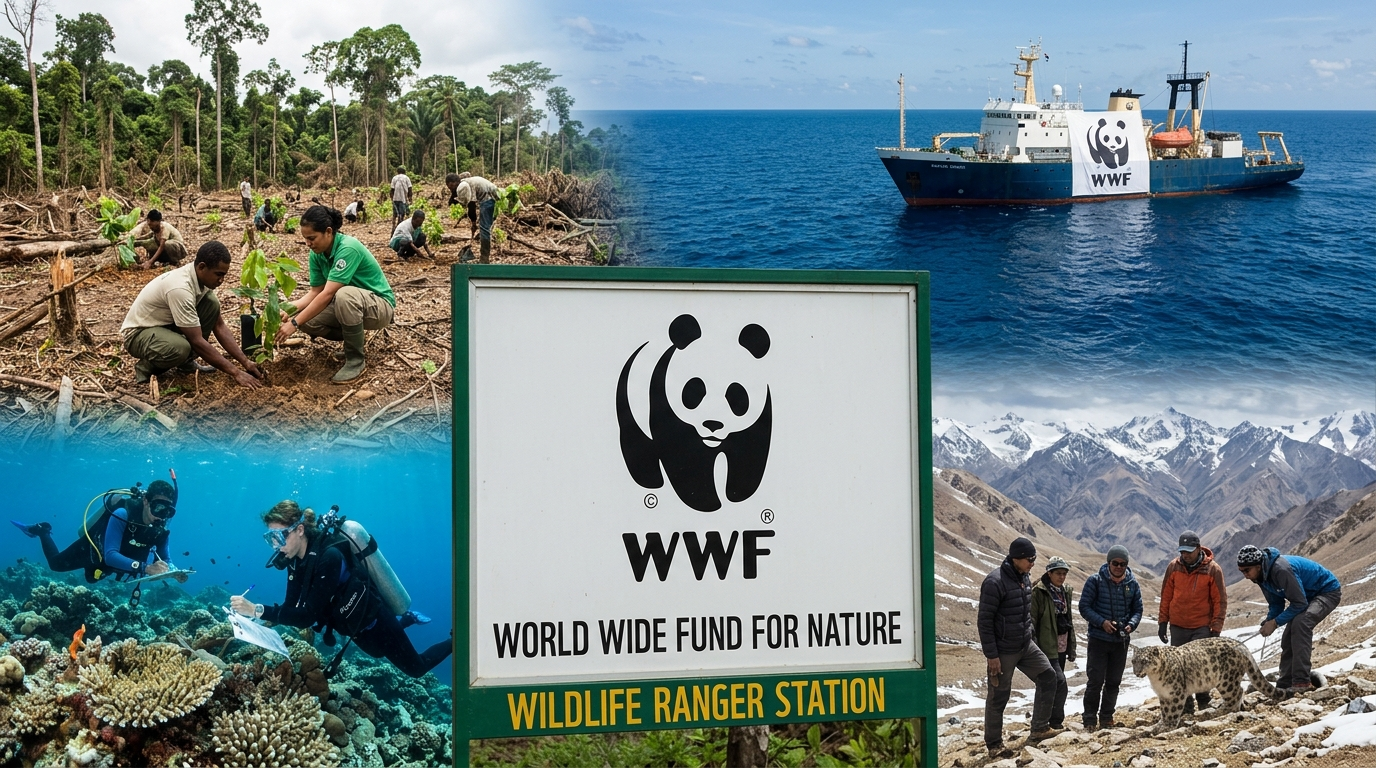
The WWF global conservation organization is one of the most recognizable environmental networks on Earth, yet its work extends far beyond saving famous animals. WWF combines field conservation, scientific research, public policy, community partnerships, corporate engagement and conservation finance to address the connected crises of biodiversity loss and climate change.
Founded in 1961, WWF has evolved from a wildlife-focused fundraising body into a worldwide network working through local leadership in more than 100 countries. Its stated mission is to stop the degradation of the natural environment and create a future in which people live in harmony with nature.
What Is the WWF Global Conservation Organization?
The WWF global conservation organization is formally known internationally as the World Wide Fund for Nature and was formerly called the World Wildlife Fund. The initials “WWF” and the black-and-white giant panda remain its most familiar global identifiers.
WWF is not a single, centrally managed charity operating identically everywhere. It is a network that includes WWF International, independently incorporated national organizations and country offices, allowing conservation strategies to be adapted to local laws, ecosystems, cultures and community priorities.
WWF at a glance
- Established: 1961
- Geographic reach: Local leadership in more than 100 countries
- Core purpose: Conserve biodiversity, support sustainable resource use, and reduce pollution and wasteful consumption
- Operating model: Field projects, advocacy, science, partnerships, public campaigns and financial-system reform
- Current strategic horizon: Roadmap 2030, with locally led and measurable conservation outcomes at its center
These features explain why the WWF global conservation organization can work simultaneously on wetland restoration, wildlife trafficking policy, sustainable food production, climate resilience and bank lending standards.
Why WWF’s Mission Is Broader Than Wildlife Protection
Wildlife conservation remains central to WWF, but protecting an animal without protecting its habitat, food supply, migration routes and surrounding communities rarely produces lasting results. That is why the WWF global conservation organization increasingly works at the level of entire landscapes, river basins, seascapes, markets and economic systems.
WWF’s official mission has three linked elements: conserving biological diversity, ensuring renewable natural resources are used sustainably, and reducing pollution and wasteful consumption. This framing treats environmental decline as a systems problem rather than a collection of isolated endangered-species emergencies.
The Six Priorities Shaping WWF’s Roadmap to 2030
WWF’s current Roadmap 2030 aligns the network around six strategic directions. The plan emphasizes measurable outcomes, systemic change and stronger leadership by Indigenous Peoples and local communities.
1. Thriving biodiversity
The WWF global conservation organization supports the protection, restoration and ecological connection of forests, grasslands, freshwater systems, coastlines and oceans. Species work is tied to habitat quality, prey availability, human-wildlife coexistence, anti-poaching efforts and legal protections.
This approach matters because a population can recover only when the ecological conditions supporting it also improve. A tiger initiative, for example, may require connected habitat, healthy prey populations, reduced illegal hunting and community-based conflict prevention rather than a single-species intervention.
2. Locally led conservation
Modern conservation is most durable when people who live closest to an ecosystem have meaningful authority, recognized rights and a fair share of benefits. WWF’s current strategy therefore calls for conservation decisions to be shaped by Indigenous Peoples, local communities, women and young people—not merely delivered to them by outside institutions.
For the WWF global conservation organization, this is both an ethical requirement and a practical one. Local knowledge can improve land management, detect environmental change earlier and produce solutions that remain viable after a time-limited project ends.
3. Transforming food and agriculture
Food systems depend on soil, water, pollinators, stable weather and genetic diversity, but they can also drive habitat conversion, water depletion and greenhouse-gas emissions. WWF works with farmers, companies, governments and consumers to reduce the ecological footprint of food production and consumption.
Typical interventions include reducing deforestation in commodity supply chains, improving fisheries and aquaculture, lowering food loss and waste, and encouraging agricultural practices that protect biodiversity. The goal is not simply “sustainable food” as a label; it is measurable improvement across land, water, climate and livelihoods.
4. Climate resilience and emissions reduction
The WWF global conservation organization treats climate and nature as interdependent. Healthy forests, peatlands, mangroves, floodplains and seagrass beds store carbon and can help buffer communities against floods, heat, erosion and storms, while climate change can weaken those same ecosystems.
Nature-based solutions are valuable when they deliver genuine emissions reductions, stronger ecosystems and benefits for local people. They should complement—not replace—rapid cuts in fossil-fuel emissions.
5. Mobilizing finance
Conservation cannot reach global scale through charitable donations alone. WWF works with banks, investors, insurers, development institutions and regulators to direct more capital toward nature-positive outcomes and reduce financing for activities that destroy ecosystems.
This is a major evolution in conservation practice. Instead of repairing damage project by project, the WWF global conservation organization also seeks to influence the financial rules and incentives that determine which infrastructure, agriculture, energy and extractive projects receive funding.
6. Elevating nature in public and political decisions
WWF engages governments, international institutions, businesses, schools and the public to make biodiversity a mainstream decision-making issue. Its methods range from policy advocacy and technical reports to campaigns such as Earth Hour, which involved participants in almost 120 countries and territories in 2025.
Public attention is not the final outcome, but it can create political permission for stronger laws, budgets and corporate standards. The best campaigns connect awareness to specific actions rather than treating visibility as impact by itself.
How the WWF Global Conservation Organization Uses Science
Science is central to WWF’s credibility, but scientific conservation involves more than publishing alarming statistics. The organization uses population monitoring, satellite data, ecological surveys, economic analysis, policy research and community knowledge to identify threats and evaluate interventions.
Its best-known research product is the Living Planet Report. The 2024 edition found that the average size of monitored vertebrate wildlife populations declined by 73% between 1970 and 2020, based on data covering more than 5,000 species.
That figure is frequently misunderstood. It does not mean that 73% of all animals have disappeared, nor does it mean that 73% of species have become extinct; it describes the average change in the size of the monitored populations included in the dataset.
The WWF global conservation organization uses findings like these to identify ecological tipping-point risks and argue for faster implementation of global biodiversity commitments. Responsible analysis should also examine regional variation, limitations in available data and whether reported activities translate into durable ecological improvements.
How WWF Funds Its Global Work
WWF receives support from individuals, governments, foundations, companies, legacies and other sources. Its 2025 annual review reported combined WWF Network gross income of approximately €1.166 billion and gross expenditure of €1.069 billion for FY25.
These are combined network figures, not consolidated accounts, because the network includes separate national organizations and country offices. WWF reported approximately €1.11 billion in donated income before adjustments involving investment values.
The reported income mix included:
- 49% from individuals
- 20% from the public sector
- 11% from corporations
- 9% from earned income
- 8% from trusts and foundations
- 3% from other sources
Financial scale gives the WWF global conservation organization substantial reach, but it also makes transparency, conflict-of-interest controls and clear impact reporting especially important.
Corporate partnerships deserve particular scrutiny. Working with influential companies can change supply chains at scale, but partnerships should include measurable targets, independent verification, public reporting and consequences when commitments are missed.
What Real Conservation Impact Should Look Like
A credible conservation program should distinguish activities, outputs, outcomes and long-term impact. Planting trees is an activity; hectares restored are an output; improved habitat connectivity is an outcome; and sustained biodiversity recovery is the deeper impact.
When assessing the WWF global conservation organization or any environmental nonprofit, look for evidence such as:
- Changes in species abundance, breeding success or mortality
- Reduced deforestation, illegal harvesting or habitat fragmentation
- Improved water quality, environmental flows or ecosystem connectivity
- Secure community land rights and stronger local governance
- Long-term financing and enforcement after a project ends
- Transparent baselines, timelines, methods and independent evaluations
This framework prevents attractive campaign numbers from being mistaken for ecological success. Ten thousand seedlings planted can sound impressive, but survival rates, native-species diversity, land tenure and protection from future clearing determine whether restoration actually works.
WWF, Human Rights and Conservation Accountability
Large conservation organizations operate in politically difficult environments, sometimes alongside state agencies responsible for protected-area enforcement. That creates serious human-rights risks when oversight, grievance procedures or safeguards are weak.
In 2019, WWF commissioned an independent review of its response to allegations of abuses by some government rangers in parts of Central Africa, India and Nepal. The panel reported that it found no evidence WWF employees directed or participated in abuse, but the review and subsequent reporting identified serious shortcomings in oversight and the need to embed human rights more consistently in conservation practice.
WWF now publishes Statements of Principles covering human rights, gender equality and Indigenous Peoples’ rights. Its Environmental and Social Safeguards Framework is designed to identify risks, prevent environmental or social harm and provide implementation and compliance mechanisms.
This matters because public trust in the WWF global conservation organization depends on both environmental results and respect for affected communities. Conservation that excludes people, weakens customary rights or lacks accessible remedies may cause harm and ultimately undermine ecological outcomes.
What Makes WWF Influential—and What Its Limits Are
WWF’s greatest strength is its ability to connect local projects with national policy, global agreements, corporate supply chains and public participation. Few conservation networks can operate across all those levels at once.
The WWF global conservation organization also benefits from a globally recognized brand, extensive partnerships and the ability to mobilize substantial funding. Those advantages can help promising local approaches attract attention and reach wider adoption.
Its size is also a limitation. A distributed network can create complex accountability lines, uneven implementation and different levels of financial detail among national offices.
WWF cannot halt biodiversity loss by itself. Governments control laws and enforcement, businesses shape production, financial institutions allocate capital, and consumers influence demand; WWF’s role is often to convene, advise, fund, pressure, test and scale solutions rather than directly control every result.
How Individuals and Organizations Can Engage Responsibly
Supporting conservation should be more deliberate than clicking a donation button after seeing an emotional wildlife image. Before contributing to the WWF global conservation organization, examine the relevant national office’s annual report, audited statements, program goals, safeguarding information and evidence of outcomes.
Individuals can also participate through volunteering, citizen science, policy advocacy, lower-impact consumption and support for locally led conservation. Businesses should go further by measuring supply-chain impacts, setting time-bound targets, publishing progress and avoiding the use of charitable partnerships as substitutes for reducing operational harm.
A useful decision rule is simple: support programs that combine ecological evidence, community rights, financial transparency and long-term durability. Strong conservation needs all four.
Frequently Asked Questions
Is WWF the same as the World Wildlife Fund?
The international organization is known as the World Wide Fund for Nature and was formerly called the World Wildlife Fund. The WWF initials and panda emblem remain the network’s common global identity, while naming conventions may differ among national organizations.
What does the WWF global conservation organization actually do?
The WWF global conservation organization protects and restores ecosystems, supports species recovery, addresses illegal wildlife trade, promotes sustainable food and resource use, advocates for climate and biodiversity policies, engages businesses and influences financial institutions. It works through partnerships rather than relying on one conservation method.
Is WWF a government organization?
No. WWF describes itself as an independent conservation organization, although its network receives funding from multiple sources and regularly works with governments, public institutions, communities, researchers and companies.
How can I tell whether WWF projects are effective?
Look for a documented baseline, measurable ecological and social targets, transparent monitoring methods, community participation, safeguard procedures and results reported over several years. The strongest evidence shows durable improvements in ecosystems and governance, not only spending totals or activity counts.
Why does WWF work with corporations?
Companies influence land use, energy, commodities, fisheries, infrastructure and finance at enormous scale. The WWF global conservation organization works with businesses to change these systems, but such partnerships are credible only when targets are specific, progress is disclosed and environmental claims can be independently checked.
Conclusion: Turn Recognition Into Informed Action
The panda logo makes WWF familiar; its real significance lies in the worldwide network behind it. The WWF global conservation organization links wildlife protection with ecosystem restoration, community rights, climate resilience, food-system reform, public policy and conservation finance.
Your next step should be practical. Identify the environmental issue that matters most to you, examine the relevant WWF program or national office, review its targets and reporting, and choose one sustained form of support—through donating, volunteering, advocating or changing an organizational practice.
Base that decision on evidence, transparency and long-term impact. Recognition creates awareness, but informed and consistent action produces conservation results.