
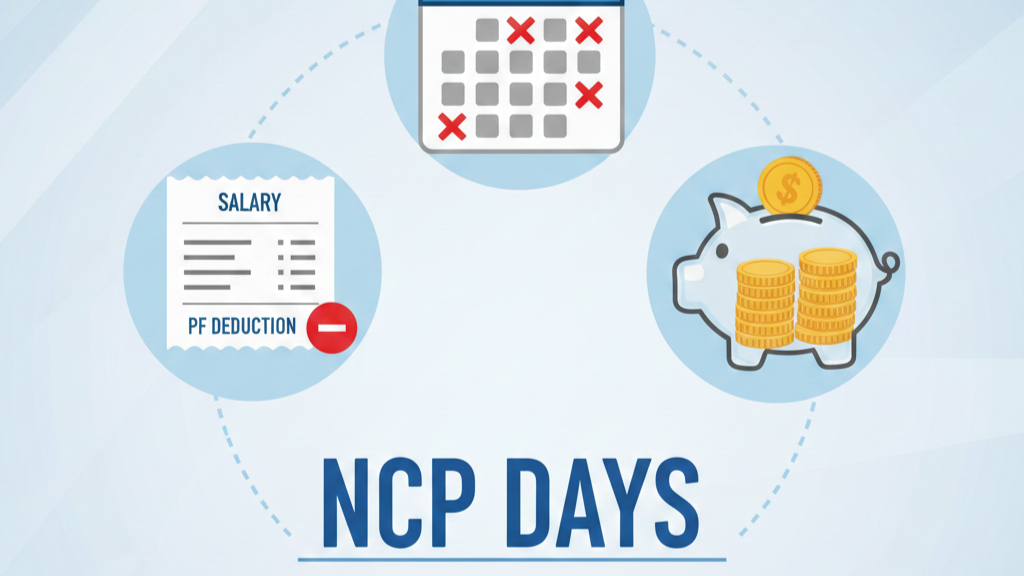
If you are an employee contributing to the Employees’ Provident Fund (EPF), you might have noticed the term NCP Days in your EPFO passbook or salary slip. Many employees often ask, What is NCP Days in EPFO and how does it affect my salary and provident fund contributions? Understanding this concept is crucial because it directly impacts your monthly PF deposit, pension contribution, and overall EPF balance.
In simple terms, NCP stands for Non-Contributory Period, and it refers to the number of days in a month for which no EPF contribution is made. These days can arise due to unpaid leave, absence without pay, or other salary deductions where no wages are earned.
In this comprehensive guide, we will explain everything you need to know — from its meaning and calculation to its impact on EPF contributions and pension benefits.
What is NCP Days in EPFO? Meaning and Full Form Explained
To clearly understand what is NCP Days in EPFO, let’s break it down:
-
NCP = Non-Contributory Period
-
EPFO = Employees’ Provident Fund Organisation
NCP Days represent the number of days in a particular month during which no EPF contribution is deposited because the employee did not receive wages for those days.
For example:
-
If you take unpaid leave for 3 days in a month,
-
And your salary is deducted for those 3 days,
-
Then those 3 days are recorded as NCP Days in EPFO.
During these days:
-
No employee contribution is deducted.
-
No employer contribution is deposited.
-
No pension (EPS) contribution is made.
These days are officially reported by the employer in the monthly EPF return filing.
Why Do NCP Days Appear in EPFO Records?
There are several reasons why NCP Days may appear in your EPFO account. These include:
1. Leave Without Pay (LWP)
If you exhaust your paid leaves and take additional leave, those days are considered unpaid. Since there is no salary, there is no PF deduction.
2. Absence Without Intimation
If an employee remains absent without approval, those days are marked as unpaid and treated as non-contributory.
3. Salary Hold or Suspension
In certain cases, salary may be withheld or partially paid. If wages are not processed for specific days, they may be marked under NCP.
4. Late Joining or Early Exit
If you join or leave an organization in the middle of a month, the remaining days of that month may be counted as non-contributory.
5. Strike or Lockout
If the company declares unpaid holidays due to a strike or lockout, those days may also be marked accordingly.
How Are NCP Days Calculated in EPFO?
Understanding how NCP Days are calculated helps you verify your EPF passbook correctly.
Basic Formula for NCP Days Calculation
Example 1:
-
Total days in April: 30
-
Paid working days: 28
-
Unpaid leave: 2 days
NCP Days = 30 – 28 = 2
Example 2:
-
Joined company on 15th of a 31-day month
-
Paid days: 17
-
NCP Days: 14
Employers are responsible for reporting accurate NCP data in the Electronic Challan cum Return (ECR) filing every month.
Impact of NCP Days on EPF Contributions
One of the biggest concerns employees have when asking What is NCP Days in EPFO is how it affects their savings.
Let’s understand the impact.
1. Reduced PF Contribution
EPF contributions are calculated based on Basic Salary + Dearness Allowance (DA).
If you have unpaid days:
-
Your salary decreases.
-
PF contribution decreases proportionally.
Lower salary = Lower PF deduction = Lower employer contribution.
2. Reduced Pension (EPS) Contribution
8.33% of the employer’s share goes toward the Employees’ Pension Scheme (EPS). If you have NCP days:
-
EPS contribution reduces.
-
This may slightly affect your pension benefits.
3. Impact on Service Period
If NCP days are significant (for example, long unpaid leave), they may affect pensionable service duration under EPS rules.
Does NCP Days Affect EPF Withdrawal?
Generally, short NCP periods do not affect EPF withdrawal eligibility. However:
-
If NCP days accumulate over long periods,
-
Or if there are continuous months with zero contributions,
-
It may create confusion in service continuity.
While withdrawing EPF, the system checks contribution history. Large gaps may require clarification from your employer.
How to Check NCP Days in EPFO Passbook?
You can check NCP days by:
-
Visiting the official EPFO Member Portal.
-
Logging in using your UAN and password.
-
Downloading your EPF passbook.
-
Reviewing monthly contribution details.
In some salary slips, NCP days are also shown under attendance or leave summary.
What is NCP Days in EPFO and Its Role in ECR Filing?
Employers file monthly EPF returns through the Electronic Challan cum Return (ECR). During this process:
-
Employers must declare wage details.
-
They must report NCP days accurately.
-
Contribution amounts are auto-calculated based on reported wages.
Incorrect reporting of NCP days can result in:
-
Wrong PF deductions
-
Compliance issues
-
Penalties from EPFO
Therefore, HR and payroll teams must maintain precise attendance records.
Common Misconceptions About NCP Days in EPFO
Misconception 1: NCP Days Mean Termination
Not true. It simply means unpaid days in a particular month.
Misconception 2: NCP Days Always Affect Pension
Short periods generally do not significantly affect pension benefits.
Misconception 3: NCP Days Reduce Entire Month’s Contribution
Only the unpaid portion is reduced, not the full month.
Difference Between NCP Days and Break in Service
Understanding this distinction is important.
| NCP Days | Break in Service |
|---|---|
| Short unpaid days | Complete employment gap |
| Employer still active | Employment discontinued |
| Temporary salary loss | Formal exit or termination |
NCP days do not automatically mean a break in service.
What Employees Should Do If NCP Days Are Incorrect
If you notice incorrect NCP days in your EPF record:
-
Check your salary slip and attendance.
-
Speak with HR or payroll department.
-
Request correction in ECR filing.
-
Employer must revise the return if needed.
You cannot directly edit NCP days yourself; only the employer can correct them.
How to Minimize the Impact of NCP Days?
While some situations are unavoidable, you can:
-
Plan leaves properly.
-
Use available paid leave first.
-
Avoid unauthorized absences.
-
Keep communication clear with HR.
Maintaining consistent salary ensures stable PF contributions and higher retirement savings.
Real-Life Scenario: Understanding NCP Days in EPFO
Let’s say:
Rahul earns ₹30,000 basic salary.
PF contribution (12%) = ₹3,600 (employee) + ₹3,600 (employer).
If Rahul takes 5 unpaid leave days in a 30-day month:
Salary becomes: ₹25,000
New PF contribution (12%) = ₹3,000
Difference:
-
₹600 less from employee side
-
₹600 less from employer side
Over time, repeated unpaid leaves can significantly reduce retirement savings.
Latest EPFO Guidelines Related to NCP Days (2026 Update)
As per recent EPFO compliance rules:
-
Employers must accurately report NCP days in monthly filings.
-
Digital verification has increased.
-
Incorrect reporting may attract penalties.
-
Online grievance redressal is available for members.
Employees can now raise complaints via the EPFiGMS portal if discrepancies occur.
Conclusion: Why Understanding What is NCP Days in EPFO Matters
Now that you clearly understand what is NCP Days in EPFO, it is evident that these non-contributory days play an important role in determining your provident fund contributions and pension accumulation.
While short periods of unpaid leave may not create major issues, repeated or extended NCP days can reduce your retirement corpus over time. Being aware of how they are calculated, reported, and reflected in your EPF passbook empowers you to track your savings more effectively.
Always review your salary slips and EPF statements regularly. If discrepancies arise, coordinate with your employer immediately. Staying informed ensures financial security and better retirement planning.
Frequently Asked Questions (FAQs)
1. What is NCP Days in EPFO in simple words?
NCP Days in EPFO refer to the number of unpaid days in a month when no provident fund contribution is made due to absence or leave without pay.
2. Do NCP days reduce my PF balance?
Yes, since PF contributions are calculated on paid salary, unpaid days reduce both employee and employer contributions.
3. Can employees correct NCP days themselves?
No, only the employer can update or correct NCP days in the EPFO return filing system.
4. Do NCP days affect pension under EPS?
Short-term NCP days usually have minimal impact. However, long non-contributory periods may affect pensionable service.
5. Are NCP days considered a break in service?
No, NCP days do not automatically mean a break in service. They only indicate unpaid days within active employment.