
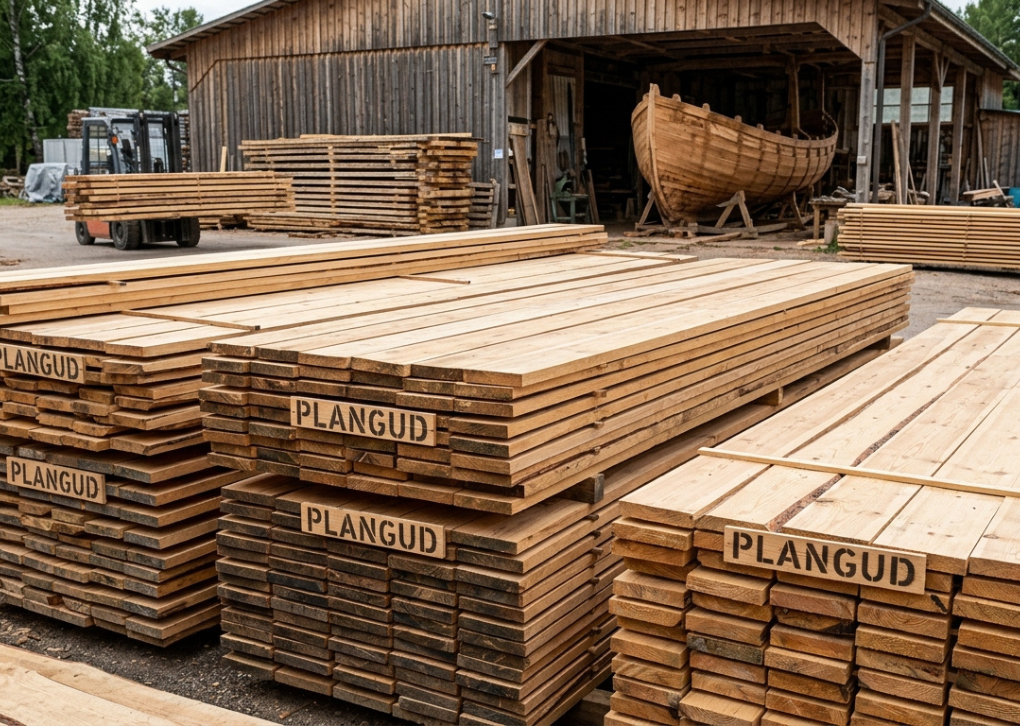
Plangud is one of those search terms that becomes more confusing the longer you browse. Some pages describe it as a productivity framework or digital planning concept, while others connect it with timber, flooring, construction, fences, and woodworking.
There is a good reason for the conflicting answers. The strongest documented linguistic evidence shows that plangud is an established Estonian word form referring to planks, while newer websites have also adopted the term for planning-related content and digital branding.
That distinction matters. Treating every online definition as interchangeable can turn speculation into apparent fact.
This guide separates the documented meaning from newer interpretations, explains how the word functions in Estonian, explores its practical timber applications, and shows how to determine what someone means when they use the term.
What Is Plangud?
In its clearest documented linguistic sense, Plangud is the plural form associated with the Estonian noun plank, referring to substantial wooden boards or planks. The Estonian explanatory dictionary describes plank as a relatively thick board and gives examples involving sawmills, flooring, fences, benches, and boats.
That gives the keyword a firmer foundation than many recent English-language explanations suggest.
At the same time, the word has acquired a second life online. The website using the name describes itself as a digital planning framework and publishes content across technology, business, lifestyle, and other categories. Its contact page also describes the property as a digital publishing platform offering guest posts, sponsored content, and backlink opportunities.
So there is no contradiction in saying that the term can appear in different contexts. What matters is distinguishing an established dictionary meaning from a modern brand name or independently created concept.
Plangud Meaning at a Glance
Readers encountering the term should consider the surrounding vocabulary.
- Timber, sawmill, wood, boards or construction: it probably refers to wooden planks.
- Flooring, furniture or boatbuilding: it is likely being used in its timber sense.
- Fence or enclosure: the related Estonian noun can also describe a solid board fence.
- Planning, goals or productivity: the writer may be using the term as a modern planning concept.
- Digital publishing or marketing: it may refer specifically to the website or brand using the name.
This context-first interpretation prevents one of the biggest problems in current search results: presenting several unrelated meanings as though they all share the same historical origin.
The Estonian Origin of Plangud
The linguistic evidence is particularly useful here because it gives us something concrete to work with.
The Estonian Language Institute’s explanatory dictionary records plank in the wood sense and includes examples such as “paksud plangud”, referring to thick planks, as well as plankudest constructions involving floors, benches, fences, and other wooden structures.
An Estonian dictionary PDF hosted by the Language Institute likewise distinguishes the wood-related plank from another identically spelled noun referring to a blank or form. The wood-related entry uses forms based on plangu and planku, while the document/form sense follows a different inflection pattern.
That grammatical detail is valuable because it demonstrates that the term is not simply a recently invented English-language internet expression.
Why the Plural Form Matters
English speakers may see the ending and assume the word is a startup name or a combination of “plan” and another syllable. Estonian morphology makes the explanation much less mysterious.
In the relevant timber sense, the relationship is essentially:
plank → plangud
Or, in straightforward English:
plank → planks
This is also independently reflected in European administrative terminology. An EU Council document translates “Plangud kimbus/kobaras/puntras” as planks supplied in a bundle, bunch, or truss.
That is strong evidence for the ordinary material meaning.
What Does a Plank Mean in This Context?
Not every piece of sawn wood is identical, and translation alone does not tell a buyer whether a particular board is appropriate for a project.
The Estonian explanatory dictionary describes the underlying timber sense as a relatively thick board, approximately 5–10 cm thick in its general dictionary definition. It provides usage examples ranging from sawmill production to floors and marine construction.
Those dimensions should not be treated as a universal commercial standard.
Timber terminology varies by country, grading system, supplier, species, manufacturing process, and whether dimensions are quoted before or after drying and machining. A product sold as a plank in one market may not match the dimensions associated with the term elsewhere.
For practical purchasing, specifications matter more than labels.
Common Uses of Plangud in Woodworking and Construction
Once the timber meaning is established, the range of applications becomes much easier to understand. Thick wooden boards have been used for centuries because they can combine structural capacity, machinability, repairability, and natural appearance.
The suitability of any particular piece, however, depends on species, grade, dimensions, moisture condition, defects, treatment, and intended exposure.
1. Furniture and Joinery
Substantial boards are useful for tables, benches, shelving, worktops, bed components, and other furniture where visual mass or structural stiffness is desirable.
A furniture maker should inspect more than appearance. Knots, checks, grain orientation, cupping, twisting, internal stress, and moisture variation can affect machining and long-term stability.
Wide material can be beautiful.
It can also move considerably when environmental humidity changes.
2. Flooring
Dictionary examples specifically document floors made from planks.
For modern flooring, though, thickness alone does not establish suitability. Wood needs to be appropriately dried and conditioned, while installation must account for expected moisture changes and the characteristics of the subfloor and indoor environment.
A board that looks perfect at the timber yard can still create gaps, distortion, or other problems if its moisture condition is incompatible with the building where it is installed.
3. Fencing
The Estonian vocabulary creates an interesting overlap here.
The base noun can refer not only to an individual thick board but also to a continuous wooden fence or enclosure. The explanatory dictionary includes examples of properties surrounded by a high board fence and people climbing over one.
Context therefore changes the appropriate English translation.
If someone is stacking Plangud, they are probably dealing with pieces of timber. A sentence about standing behind or climbing over a related singular form may instead concern a fence.
4. Boat and Marine Construction
The dictionary also records compounds and examples associated with ships and boats.
That historical vocabulary should not be mistaken for material-selection guidance. Marine timber faces demanding conditions, and the appropriate species, fastening system, treatment, grain quality, dimensions, and construction technique depend on the vessel and environment.
In other words, knowing what the word means is only the beginning.
How to Evaluate Plangud Before Buying Timber
If you encounter Plangud in a Baltic timber catalogue, marketplace listing, or supplier quotation, do not purchase based on the translated product name alone.
Request measurable specifications.
The most useful checks include:
- Wood species: pine, spruce, oak, or another species can behave very differently.
- Actual dimensions: confirm thickness, width, and length rather than assuming a standard.
- Moisture content: particularly important for indoor furniture and flooring.
- Grade: understand what defects and tolerances the seller permits.
- Surface condition: establish whether material is rough-sawn, planed, sanded, or otherwise finished.
- Edge treatment: determine whether boards are square-edged, waney-edged, profiled, or machined for joinery.
- Drying method: ask whether the material is air-dried, kiln-dried, or supplied green.
- Treatment: exterior timber may require appropriate preservation or finishing.
- Intended application: structural and decorative requirements are not interchangeable.
- Quantity calculation: allow for cutting waste and the rejection of unsuitable sections where appropriate.
This approach is far safer than assuming that all products carrying the same translated noun have identical properties.
Plangud as a Digital Planning Concept
This is where the search landscape becomes complicated.
Several recent English-language pages describe Plangud as a flexible planning philosophy, productivity methodology, project-management concept, or digital collaboration system. Yet these descriptions are not consistent with one another. One source explicitly says there is no single official definition and treats it as a flexible planning approach rather than a specific application.
Another describes it more cautiously as a context-dependent online term associated with goals, workflows, tasks, and organization, while acknowledging that no universally accepted definition has been established.
That uncertainty should be disclosed rather than hidden.
Is It Really a Productivity Method?
Based on the available evidence, it is safer to describe planning-related uses as modern interpretations or branding, not as the historical meaning of the word.
There is an active website carrying the name and presenting itself as a digital planning framework. However, its current homepage functions largely as a multi-topic publication with articles covering business, technology, lifestyle, and other subjects.
Its own contact information goes further, describing opportunities involving guest posts, backlinks, and sponsored posts.
This matters for E-E-A-T because a careful researcher should distinguish between:
what a source calls itself, what functionality can actually be verified, and what independent evidence establishes.
Those are not automatically the same thing.
A Practical Planning Framework Inspired by the Online Interpretation
Even if the planning interpretation is newer, the ideas associated with it can still be useful when clearly presented as a framework rather than historical fact.
A sensible adaptive workflow looks like this:
Purpose → Goal → Milestones → Actions → Review → Adjustment
Start by defining the outcome rather than creating a giant task list. Break the result into measurable milestones, identify the next executable actions, and assign realistic priorities.
Then review the plan.
That last step is crucial. A plan should be a decision-making system, not a frozen prediction about the future.
Example: Planning a Website Launch
Suppose a business wants to launch a new website.
“Build website” is too broad to manage effectively. A stronger workflow would separate the project into discovery, information architecture, copywriting, design, development, technical SEO, quality assurance, analytics setup, launch, and post-launch monitoring.
Each stage can then receive an owner, deadline, dependency, and success criterion.
If development takes longer than expected, the entire project does not need to be labelled a failure. The team updates dependencies, protects the critical path, moves lower-priority work, and establishes a new forecast.
That is adaptive planning in practice.
Whether someone chooses to call that approach Plangud is secondary to whether the workflow actually improves decisions and execution.
Plangud vs Traditional Task Management
Traditional task management often focuses on completion:
What needs to be done?
A more strategic planning system asks several additional questions:
Why does this task exist? What outcome does it support? What depends on it? What changed since the plan was created?
That distinction can make planning substantially more useful.
A sophisticated system connects four levels:
Objectives establish direction.
Milestones make progress measurable.
Tasks convert strategy into action.
Reviews test whether the original assumptions remain valid.
The mistake is believing that another branded methodology automatically creates productivity.
Tools cannot repair unclear objectives.
Why Search Results About Plangud Conflict
The confusion surrounding Plangud is a useful case study in how search ecosystems evolve.
A relatively unfamiliar foreign-language word creates an information gap for English-speaking searchers. Publishers notice the query, produce interpretations, and sometimes use previous articles as implicit evidence for subsequent ones.
Eventually, repetition can make an unsupported definition appear established.
That is why source hierarchy matters.
For linguistic questions, an established language institute or dictionary deserves more weight than a recently published lifestyle article. For software claims, product documentation, demonstrable functionality, privacy information, pricing documentation, and independent testing deserve more weight than generic descriptions.
Repetition is not verification.
That principle applies far beyond this keyword.
Common Misconceptions About Plangud
One widespread misconception is that the term has only recently appeared. Its underlying Estonian vocabulary is documented independently of the current wave of English-language articles.
Another is that it definitively means “good planning” because the spelling can be visually separated into something resembling “plan” and “gud.” That may work as contemporary wordplay or branding, but visual resemblance is not etymological evidence.
A third misconception is that every mention refers to a software product. Current search results include planning interpretations, a publishing website, and the established timber meaning, so context must determine the intended sense.
Finally, the word alone is not a timber specification. Buyers still need dimensions, species, moisture data, grade, finish, treatment, and other application-specific information.
How to Identify the Intended Meaning
A quick contextual test usually solves the problem.
When the surrounding text includes timber, sawmill, wood species, flooring, fence, boards, furniture, construction, boat, thickness, or moisture, interpret the term through its established wood-related meaning first.
When you see tasks, productivity, goals, workflows, collaboration, strategy, digital planning, or project management, you are probably reading a newer planning-oriented interpretation.
If the term appears as a proper name, inspect the organization or website itself before assuming that dictionary definitions explain the brand.
This simple semantic check is more reliable than forcing every occurrence into a single definition.
Why the Distinction Matters
Accuracy is not merely academic.
A buyer researching timber needs product specifications. A person looking for productivity software needs features, integrations, pricing, security information, and platform availability. Someone translating Estonian needs linguistic accuracy.
Giving all three users the same answer fails search intent.
The strongest content therefore does something search-engine summaries often cannot: identify the intent behind the query and explain where the evidence changes.
That is the real key to understanding Plangud.
Frequently Asked Questions About Plangud
What does Plangud mean?
Plangud is an Estonian word form associated with multiple planks or substantial wooden boards. The Estonian explanatory dictionary documents the underlying plank noun and gives examples involving thick boards, sawmills, floors, fences, benches, ships, and boats. The same name has also acquired newer planning and digital uses online.
Is Plangud an Estonian word?
Yes. The wood-related word family is documented in Estonian dictionaries, including examples containing plangud and related grammatical forms. This provides much stronger linguistic evidence than theories based purely on how the spelling looks to an English speaker.
Is Plangud a planning or productivity tool?
The name is used online in connection with planning and productivity, and a website using it describes itself as a digital planning framework. However, recent sources disagree about whether it should be understood as a platform, methodology, concept, or general planning philosophy. The safest interpretation is that these are newer digital uses of the name, distinct from its documented Estonian meaning.
Can Plangud refer to flooring and construction materials?
Yes. The established timber meaning naturally occurs in woodworking and construction contexts, and the Estonian explanatory dictionary specifically contains examples involving plank floors and other structures made from thick boards. Suitability for a real project still depends on specifications such as species, dimensions, moisture condition, grade, machining, and intended use.
How do I know which meaning of Plangud is correct?
Look at the surrounding vocabulary and the authority of the source. Timber, boards, flooring, fences, or woodworking point toward the Estonian wood meaning; productivity, goals, tasks, and workflows usually indicate a modern planning interpretation; and use as a capitalized website or organization name may simply represent branding. Context should determine the interpretation rather than assuming every occurrence has the same meaning.
Conclusion: Understand the Context Before You Use the Term
Plangud is much less mysterious once documented facts are separated from recent online interpretations.
Its strongest established linguistic meaning comes from Estonian: the word is associated with planks or substantial wooden boards, with dictionary evidence covering timber, flooring, fencing, and marine contexts. Modern websites have subsequently used the same term in planning, productivity, publishing, and branding contexts, but those uses should not be presented as though they automatically share the word’s linguistic origin.
If you are buying timber, ignore vague labels and request measurable specifications. If you are evaluating a planning platform or methodology, look for verifiable functionality, documentation, ownership, pricing, privacy practices, integrations, and independent evidence.
And if you are simply trying to understand the keyword, use the most reliable rule of all: check the context, identify the source, and separate documented meaning from interpretation.
That gives you a clearer—and far more defensible—understanding of Plangud.