
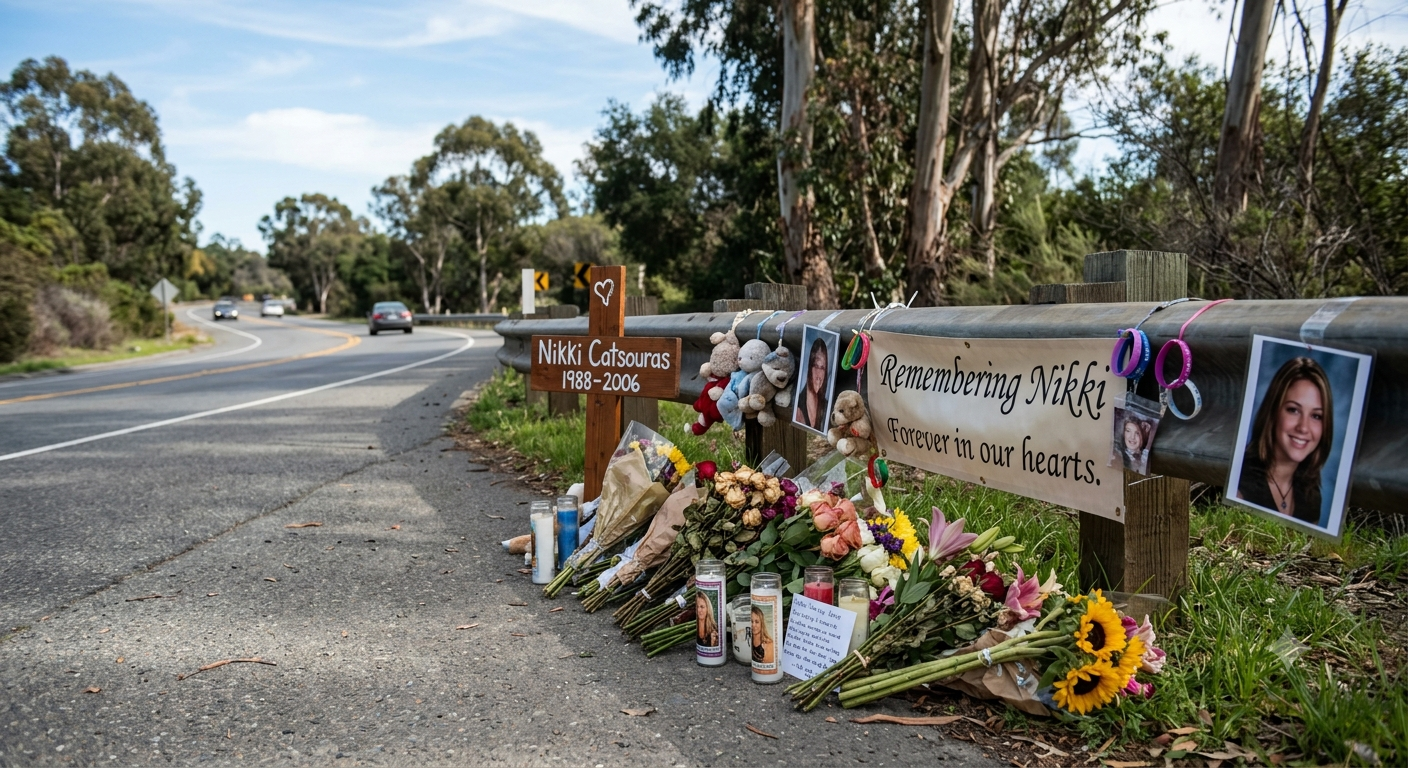
The Nikki Catsouras death story is often reduced online to a shocking car crash, but that framing misses the most consequential part of what happened. Nikki was an 18-year-old California woman who died in a high-speed collision on October 31, 2006; afterward, official scene photographs were improperly circulated outside the California Highway Patrol and eventually spread across the internet.
The case became important far beyond one family. It raised difficult questions about the responsibilities of public employees, the privacy interests of surviving relatives, the permanence of digital material, and the damage that can occur when official death-scene imagery becomes online entertainment.
A California appellate court later allowed important privacy, emotional-distress, and negligence claims to proceed. The California Highway Patrol ultimately settled with the Catsouras family for approximately $2.37 million in 2012.
This article focuses on documented facts and the legal record. It does not reproduce, provide access to, or describe the leaked photographs in graphic detail.
Quick Facts About the Nikki Catsouras Death
Nikki Catsouras, also identified as Nicole Catsouras in legal records and reporting, was born on March 4, 1988, and died on October 31, 2006, at age 18. Her published obituary listed her parents, Lesli and Christos Catsouras, along with her three sisters, and stated that her funeral was held at Saddleback Church in Lake Forest, California.
The crash occurred on State Route 241, commonly known as the 241 Toll Road, in Orange County. Contemporary reporting states that Catsouras was driving her father’s Porsche at more than 100 mph when she clipped another vehicle, lost control, and crashed into a toll-booth structure.
For anyone researching the Nikki Catsouras death, the central distinction is important: the fatal crash and the later privacy controversy were two separate events. The case became internationally notorious because official collision-scene photographs escaped the investigative context in which they had been created.
Key verified facts include:
- Date of death: October 31, 2006
- Age: 18
- Location: 241 Toll Road near Lake Forest, Orange County, California
- Vehicle: Porsche belonging to her father
- Public controversy: Unauthorized dissemination of official crash-scene photographs
- Major legal development: A 2010 California appellate decision recognized a surviving family’s potential common-law privacy interest in a loved one’s death images
- Settlement: Approximately $2.37 million with the California Highway Patrol in 2012
What Happened in the Nikki Catsouras Death Crash?
According to contemporaneous Los Angeles Times reporting, Catsouras took her father’s Porsche without permission and drove onto the 241 Toll Road. While traveling at very high speed, she clipped a Honda Civic while attempting to pass it and lost control of the Porsche.
The car then left its intended path and struck a toll-booth structure. Nikki died at the scene. Investigators photographed the collision site as part of the official response to the fatal crash.
Those investigative photographs would later become the center of an extraordinary privacy dispute.
It is important to distinguish documented information about the Nikki Catsouras death from rumors that accumulated afterward. Over many years, the story has been reposted on anonymous forums, image-sharing pages, sensational blogs, and social networks, frequently alongside claims with no reliable sourcing.
For responsible research, the California appellate opinion, contemporary reporting from established news organizations, and government legislative materials are far stronger sources than anonymous posts or websites built primarily to display shocking content.
How Did the Nikki Catsouras Death Photos Reach the Internet?
This is the central question behind the controversy.
The photographs were created in an official law-enforcement context. They were not supposed to become material for casual public distribution or online entertainment. Contemporary reporting stated that they were never intended for public release.
The Catsouras family’s lawsuit focused on CHP employees Thomas O’Donnell and Aaron Reich. The California Court of Appeal described allegations that nine sensitive photographs were emailed to friends and family members outside the investigative process and then forwarded further, eventually spreading across large numbers of websites.
In February 2007, the CHP acknowledged after an internal investigation that someone inside the agency had been responsible for the improper release. The agency also said that steps had been taken to prevent a similar incident.
That is what transformed the Nikki Catsouras death into an early example of one of the internet’s most difficult privacy problems.
Once sensitive digital material escapes its intended chain of custody, meaningful control can disappear almost instantly. One copy becomes ten. Ten become hundreds. Files move between email accounts, forums, mirrors, archives, private messages, and websites.
Removing the original upload no longer guarantees removal of everything that came after it.
The Harassment of the Catsouras Family
The online dissemination did not remain confined to distant websites.
According to contemporary reports and the court record, members of the Catsouras family began receiving photographs through emails and messages. Some communications were deliberately structured to surprise or distress recipients.
This distinction is essential to understanding the harm.
A photograph merely existing somewhere online creates one type of privacy problem. Targeted delivery to grieving relatives creates another. It transforms circulation into direct harassment.
The family also described restricting ordinary internet use because routine searching could expose them to the photographs. Los Angeles Times reporting later noted that family members avoided some online activity out of fear that the images would appear unexpectedly.
The Nikki Catsouras death was therefore not simply an early story about something “going viral.” It became an example of secondary victimization, where technology allowed strangers to repeatedly reintroduce a family to the most traumatic moment of their lives.
Why the 2010 Court Ruling Mattered
The major legal turning point came in Catsouras v. Department of California Highway Patrol, reported at 181 Cal.App.4th 856.
A lower court had dismissed important parts of the family’s case. In 2010, however, the California Court of Appeal reversed the dismissal of several significant claims.
The appellate court made a particularly important distinction.
Generally speaking, a deceased person’s personal privacy rights do not simply continue indefinitely after death. But the court reasoned that surviving family members could possess their own privacy interest in death images of a loved one, subject to legal limitations.
That meant the issue was not merely whether Nikki herself retained a posthumous personal privacy claim.
The legal question was also whether her parents and siblings had independent interests that could be harmed when highly sensitive official photographs of their deceased relative were improperly distributed.
The court allowed the family’s invasion-of-privacy theory to proceed and also found sufficient allegations involving intentional infliction of emotional distress.
On negligence, the appellate court concluded that the CHP and its employees could owe a duty of care not to place official death imagery onto the internet for what the court characterized as “vulgar spectacle.”
This made the Nikki Catsouras death case a significant development in California privacy law.
Importantly, the ruling did not establish that every piece of information concerning a deceased person becomes private.
The issue was much narrower: highly sensitive postmortem imagery obtained by authorities, disseminated outside legitimate investigative purposes, and capable of causing foreseeable harm to surviving relatives.
The $2.37 Million CHP Settlement
In January 2012, the California Highway Patrol reached a settlement with the Catsouras family worth approximately $2.37 million.
The settlement followed several years of litigation and came after the appellate ruling had revived major parts of the family’s case.
At the time, CHP spokesperson Fran Clader acknowledged that financial compensation could not undo the family’s suffering and said the resolution was intended to bring the litigation to an end.
Yet even a multimillion-dollar settlement could not solve the underlying technological problem.
The internet could not simply be reset.
That remains one of the harshest lessons of the Nikki Catsouras death controversy: courts can impose accountability, organizations can change procedures, and victims can receive compensation, but retrieving every unauthorized copy of digital material after global distribution may be practically impossible.
Why the Nikki Catsouras Death Became a Landmark Internet-Privacy Story
In 2006, Facebook had only recently opened beyond college networks, smartphones had not yet become ubiquitous, and today’s major algorithm-driven social platforms did not operate in their current form.
Yet digital distribution was already powerful enough to create permanent loss of control.
The Catsouras case demonstrated three problems that would become even more important during the following two decades.
The images originated with a public agency
The photographs were not simply created by a random person observing an accident.
They existed because government personnel were documenting a fatal collision.
That brought professional responsibility, evidence handling, institutional trust, and public-sector privacy obligations into the story.
The emotional harm was foreseeable
The appellate court placed considerable emphasis on foreseeability when examining the negligence issue. Disseminating highly sensitive photographs involving someone’s deceased child or sibling carried an obvious potential for serious emotional harm.
Digital distribution was persistent
The family attempted to have copies removed from websites, but the material repeatedly surfaced elsewhere.
The Los Angeles Times reported in 2010 that a reputation-management company working with the family said it had persuaded websites to remove thousands of copies, while the photographs nevertheless continued spreading.
That persistence is why the Nikki Catsouras death remains relevant to debates about digital privacy, content moderation, official evidence handling, search engines, online harassment, and the responsibilities of people who encounter leaked material.
Search intent around Nikki Catsouras death should therefore be answered through documented history and legal context—not simply through sensational descriptions of the collision.
The Case’s Influence on Later Privacy Disputes
The significance of Catsouras did not end with the 2012 settlement.
California legislative analyses subsequently referenced the decision when discussing the privacy interests that relatives may have in postmortem images. A 2016 California legislative analysis described Catsouras as an important authority concerning surviving family members’ privacy interests in a loved one’s death imagery.
The case has also appeared in later California appellate decisions involving highly private visual material.
In Jackson v. Mayweather, Jr., for example, a California Court of Appeal cited the Catsouras decision when discussing circumstances in which publication of private imagery could lack a legitimate public purpose.
Its broader cultural relevance became particularly visible after the January 2020 helicopter crash that killed Kobe Bryant, his daughter Gianna, and seven other people.
Los Angeles Times reporting later stated that then-Los Angeles County Sheriff Alex Villanueva thought about the Catsouras controversy while confronting allegations involving the sharing of photographs from the Bryant crash scene.
The cases are legally and factually distinct.
Still, the comparison demonstrates how the Nikki Catsouras death controversy became a reference point for public agencies facing allegations that first responders had mishandled sensitive images of deceased people.
What the Story Teaches About Digital Ethics
It is tempting to treat early internet controversies as products of a less mature online era.
That would be a mistake.
Today, screenshots, encrypted messaging groups, cloud backups, private servers, algorithmic recommendations, repost accounts, and cross-platform sharing can make containment even more difficult.
The Nikki Catsouras death illustrates several ethical rules that remain relevant for publishers, researchers, website owners, social-media users, journalists, and content creators:
- Public curiosity is not automatically public interest. A fatal accident may be newsworthy without every photograph from the scene having legitimate news value.
- The source of material matters. Information appearing online does not mean it was lawfully or ethically released.
- Reposting creates additional distribution. Someone who did not cause the original leak can still increase its reach.
- Surviving relatives matter. Ethical publishing considers foreseeable harm to the family of a deceased person.
- Graphic material does not become educational simply because someone labels it that way.
- Search traffic is not an ethical justification. A publisher’s ability to rank for a shocking image query does not make publication necessary.
For SEO publishers specifically, the Nikki Catsouras death demonstrates that meaningful information gain can come from verified chronology, primary legal sources, institutional accountability, privacy analysis, and digital-ethics guidance.
There is no need to republish invasive imagery to create authoritative content.
Why Responsible Articles Should Not Embed the Leaked Images
A responsible article about the Nikki Catsouras death does not require the photographs to tell the story accurately.
In fact, republishing them risks repeating the exact pattern of uncontrolled dissemination that ultimately made the case legally significant.
There is also little genuine information gain in showing readers imagery that has circulated for years.
The far more useful editorial questions are:
How did restricted images escape institutional control? Why did the court believe surviving relatives could have privacy rights? What responsibilities did the CHP have? Why was the internet unable to contain the leak afterward?
Answering those questions gives readers knowledge they did not have before.
Websites should similarly avoid “click to see the photos,” “uncensored images,” or comparable language. Such framing converts a meaningful privacy case into an invitation to participate in the same cycle of sensational distribution the Catsouras family spent years fighting.
Common Misinformation About the Nikki Catsouras Death
Because the Nikki Catsouras death has been discussed on forums, shock sites, social platforms, video channels, archived pages, and repost blogs for nearly two decades, low-quality information often appears next to legitimate reporting.
One common mistake is assuming that every widely repeated statement must be established fact.
It isn’t.
Another is confusing allegations made in litigation with facts definitively established after a full trial. That distinction matters because the case eventually settled rather than proceeding through a complete trial on every disputed factual question.
Researchers should prioritize sources roughly in this order:
- Published judicial opinions and court records
- Contemporary reporting from established news organizations
- Government or legislative documents discussing the case
- Later reputable reporting explaining its legal impact
- Secondary summaries only when they clearly cite stronger original sources
Researchers should be especially skeptical of pages that expose personal contact details, repeat unsupported allegations, or exist mainly to distribute disturbing imagery.
Ranking highly in search results does not make a webpage authoritative.
Timeline of the Nikki Catsouras Death and Legal Case
March 4, 1988: Nikki Catsouras is born.
October 31, 2006: Catsouras, age 18, dies following the Porsche crash on the 241 Toll Road in Orange County.
Late 2006: Official crash-scene photographs begin circulating online after copies leave the CHP investigative context.
February 2007: The Los Angeles Times reports that a CHP investigation concluded someone inside the agency was responsible for the improper release.
2008: A lower court dismisses major portions of the family’s lawsuit.
February 2010: The California Court of Appeal reverses key portions of the earlier ruling, allowing significant privacy, emotional-distress, and negligence theories to proceed.
January 2012: The CHP settles with the Catsouras family for approximately $2.37 million.
Later years: Courts, California lawmakers, journalists, and public agencies continue referring to the case when discussing family privacy and sensitive postmortem imagery.
Taken together, the timeline explains why Nikki Catsouras death searches continue to surface discussions extending far beyond the circumstances of the original crash.
FAQ About the Nikki Catsouras Death
What caused Nikki Catsouras’ death?
Nikki Catsouras died after losing control of her father’s Porsche on the 241 Toll Road in Orange County, California, on October 31, 2006.
Contemporary Los Angeles Times reporting states that she was traveling at more than 100 mph, clipped another vehicle while attempting to pass, lost control, and crashed into a toll-booth structure. She was 18 years old.
Why did the Nikki Catsouras death photos become controversial?
The photographs were official crash-scene images associated with a California Highway Patrol investigation rather than ordinary photographs voluntarily released by the family.
Copies were improperly distributed outside the investigative process and subsequently spread across the internet. Members of the Catsouras family were also directly targeted with the imagery, turning a privacy breach into an ongoing source of emotional distress.
Who leaked the Nikki Catsouras photographs?
The family’s lawsuit focused on CHP employees Thomas O’Donnell and Aaron Reich.
The 2010 appellate opinion describes allegations concerning the distribution of photographs outside the investigation, after which copies were forwarded and spread online. Separately, the CHP acknowledged following an internal investigation that someone inside the agency had been responsible for the improper release.
Did the Catsouras family win the lawsuit?
The legal history cannot accurately be reduced to a simple courtroom “win.”
A lower court initially dismissed significant claims, but the California Court of Appeal reversed important portions of that ruling in 2010. The appellate court allowed the family to proceed with theories involving invasion of privacy, intentional infliction of emotional distress, and negligence.
Before a complete trial resolved every remaining issue, the CHP agreed to an approximately $2.37 million settlement with the family in 2012.
Why is the Nikki Catsouras death case still important?
The Nikki Catsouras death case helped establish an important distinction in California law: although a deceased person’s ordinary personal privacy claims generally do not simply transfer to relatives, surviving family members may have their own common-law privacy interest in certain death images, subject to legal limitations.
The controversy also demonstrated how quickly sensitive material can escape institutional control and how difficult complete removal becomes after widespread digital copying.
Nearly two decades later, that lesson remains highly relevant.
Conclusion: Remember the Privacy Lesson, Not the Spectacle
The Nikki Catsouras death was a devastating 2006 traffic fatality, but its lasting public significance comes largely from what happened after the crash.
Sensitive official photographs escaped their investigative context. Copies spread online. Strangers used them to torment a grieving family. The resulting litigation forced California courts to examine how traditional privacy principles should operate when postmortem imagery can be duplicated endlessly on the internet.
The case eventually produced an approximately $2.37 million settlement and became an important reference point in later discussions involving family privacy and death-scene photographs.
For readers, researchers, and publishers, the best next step is straightforward: use court decisions and reputable reporting, reject unverified claims, avoid distributing the leaked photographs, and focus on the legal and ethical lessons instead of the spectacle.
That is the most responsible—and genuinely informative—way to understand the Nikki Catsouras death.