
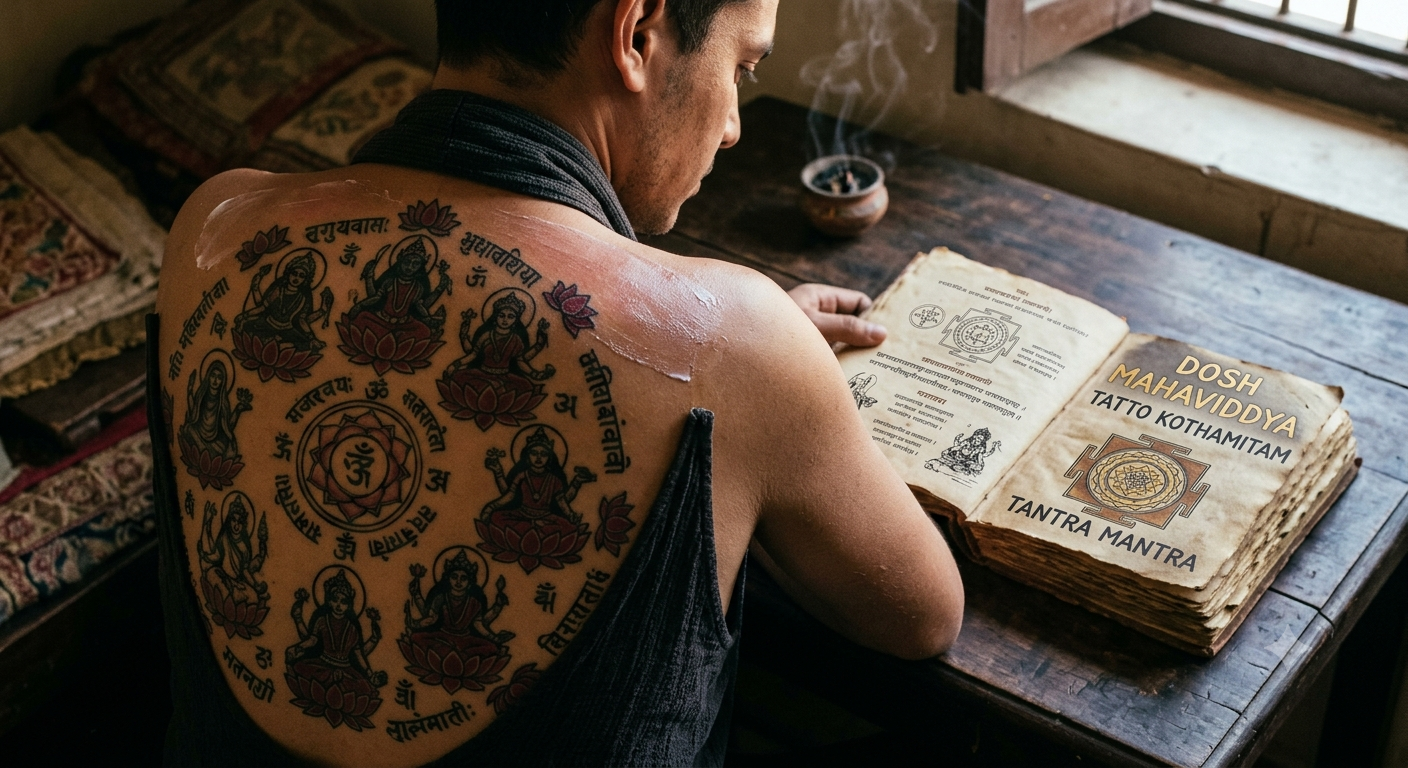
The Dosh mahavidda tatto kothamitam tantra mantra book is frequently searched under an approximate English transliteration rather than its formal published title. The book most likely being sought is Sri Sri Chandi & Dasamahavidya Tattwa Kathamritam, a Bengali-language work attributed to Madhusudan and published by Ananda Prakashan of Kolkata.
That distinction matters. A person searching with the misspelled phrase may encounter unrelated tantra manuals, unauthorized scans, incomplete editions or books with similar covers. Identifying the correct Bengali title, ISBN and publisher is therefore the safest way to find the intended work.
Available catalog information describes the book as a 328-page Bengali hardcover, published by Ananda Prakashan, Kolkata, with ISBN 9788188163731. One specialist retailer identifies a 2016 edition, while an indexed Amazon listing gives a 2024 publication date, which may represent a later listing or reissue rather than the original edition.
What Does “Dosh Mahavidda Tatto Kothamitam Tantra Mantra Book” Mean?
The phrase Dosh mahavidda tatto kothamitam tantra mantra book appears to be a phonetic rendering of Bengali and Sanskrit-derived words. It is not the standardized Roman spelling of the published title.
A more accurate transliteration is:
Sri Sri Chandi O Dasamahavidya Tattwa Kathamritam
The Bengali title is:
শ্রীশ্রী চণ্ডী ও দশমহাবিদ্যা তত্ত্বকথামৃত
The main words can be understood as follows:
- Dasha or Dasa means ten.
- Mahavidya means “great knowledge,” “great wisdom” or a great form of sacred revelation.
- Tattwa or Tattva refers to principle, truth, essence or underlying reality.
- Kathamritam combines the ideas of sacred narrative and nectar-like teaching.
- Chandi refers to the fierce and protective form of the Goddess celebrated in the Devi Mahatmya.
- Tantra refers to a diverse collection of religious texts, ritual systems and theological traditions.
- Mantra means a sacred utterance, formula, syllable or sequence used within devotional and ritual practice.
Consequently, the title may be translated approximately as “Sri Sri Chandi and the Nectar of Teachings on the Principles of the Ten Mahavidyas.” This translation communicates the general meaning, although English renderings can differ because Sanskrit and Bengali religious terminology rarely maps perfectly onto a single English phrase.
Quick Facts About the Dosh Mahavidda Tatto Kothamitam Tantra Mantra Book
Here are the most consistently documented details:
- Full title: Sri Sri Chandi & Dasamahavidya Tattwa Kathamritam
- Original title: শ্রীশ্রী চণ্ডী ও দশমহাবিদ্যা তত্ত্বকথামৃত
- Author: Madhusudan, sometimes cataloged as Sri Madhusudan
- Publisher: Ananda Prakashan, Kolkata
- Language: Bengali
- Format: Hardcover
- Length: 328 pages
- ISBN: 9788188163731
- Documented edition: 2016
- Approximate dimensions: 21.5 × 14 cm
- Approximate weight: 420 grams
These specifications come from a specialist catalog listing rather than an examination of every printing. Buyers should still compare the copyright page and ISBN because cover designs, prices and printing dates may change.
The phrase Dosh mahavidda tatto kothamitam tantra mantra book may also lead to videos or online sellers using simplified spelling. One indexed video uses almost the exact search phrase while displaying the Bengali description “দশ মহাবিদ্যা তন্ত্র মন্ত্র পূজা পাঠ বই,” demonstrating how the misspelling likely spread through phonetic transcription and product searches.
What Is the Religious Background of the Book?
Understanding the book requires familiarity with two connected but distinct subjects: Sri Sri Chandi and the Dasha Mahavidyas.
Sri Sri Chandi and the Devi Mahatmya
“Chandi” is a widely used name for the Goddess presented in the Devi Mahatmya, also known as the Durga Saptashati or Chandi Path. The Sanskrit work is traditionally situated within the Markandeya Purana and is structured around the Goddess’s victories over disruptive forces represented by figures such as Mahishasura, Shumbha and Nishumbha.
The Devi Mahatmya contains approximately 700 verses arranged into 13 chapters. Academic scholarship treats it as a foundational text in the historical development of Goddess-centered Hindu traditions, while devotional communities approach it as sacred scripture for recitation, worship and theological reflection.
Its importance extends beyond the narration of battles. The Goddess is presented not merely as the companion of a male deity but as an encompassing divine reality associated with creation, preservation, dissolution, knowledge, sleep, power and liberation.
A book combining Chandi with Mahavidya teachings therefore sits at the intersection of Shakta theology, Bengali devotional culture, sacred storytelling and Tantric interpretation.
What Are the Ten Mahavidyas?
The Mahavidyas are commonly described as a group of ten powerful manifestations of the Divine Feminine within Hindu Tantric and Shakta traditions. The word combines maha, meaning great, and vidya, meaning knowledge, wisdom, revelation or sacred understanding.
The most commonly recognized ten are:
- Kali
- Tara
- Tripura Sundari, also called Shodashi
- Bhuvaneshvari
- Bhairavi
- Chhinnamasta
- Dhumavati
- Bagalamukhi
- Matangi
- Kamala
This list is widely used, although ordering, names, theological interpretation and ritual emphasis may vary between lineages and regional traditions. Scholars also emphasize that the Mahavidyas should not be reduced to ten interchangeable versions of one simple idea. Each possesses distinctive mythology, iconography, devotional character and philosophical significance.
David Kinsley’s academic study of the Mahavidyas highlights how several of these goddesses challenge ordinary social expectations through imagery connected with death, disorder, sexuality, marginality, sovereignty and transformation. Their apparently unsettling forms are part of the theological depth of the tradition rather than decorative horror imagery.
What Does the Dosh Mahavidda Tatto Kothamitam Tantra Mantra Book Cover?
The complete table of contents is not reliably reproduced in the publicly accessible catalog records reviewed for this article. It would therefore be misleading to claim a specific number of mantras, rituals, yantras or chapters without inspecting the physical edition.
Based on its verified title, classification and sample-page listing, the Dosh mahavidda tatto kothamitam tantra mantra book appears to connect two major bodies of Goddess tradition:
- The narrative and theological world of Sri Sri Chandi
- The identities and principles of the Ten Mahavidyas
- Bengali explanations of relevant sacred concepts
- Stories associated with different forms of Shakti
- Devotional interpretation
- Discussions of tattva, or underlying spiritual principles
- Material related to mantra, worship or traditional practice
This should be understood as a responsible description of the book’s apparent scope, not a page-by-page content claim. The retailer provides sample-page images but does not publish a fully searchable textual contents list.
That limitation is important because some online descriptions use “tantra mantra book” as a broad marketing phrase. A book may discuss mantra and Tantric theology without functioning as a complete ritual manual, initiation guide or independent course of practice.
Why People Search for This Book
Interest in the Dosh mahavidda tatto kothamitam tantra mantra book usually comes from several different reader intentions.
Some readers want a Bengali introduction to the Ten Mahavidyas. Others are specifically looking for information about Chandi worship, Shakta philosophy, Goddess mythology or the relationship between the Devi Mahatmya and later Tantric traditions.
The book may be relevant to:
- Bengali readers exploring Shaktism
- Students of Hindu religious literature
- Readers researching Kali, Tara or Tripura Sundari
- People interested in Chandi Path and Durga Saptashati
- Researchers comparing Bengali and Sanskrit religious terminology
- Collectors of regional spiritual books
- Devotees seeking a traditional explanatory text
- Readers studying mantra, yantra and tantra at a historical or theological level
However, readers looking for an English translation should note that the documented edition is in Bengali. A basic ability to recognize the script may not be sufficient because religious vocabulary can involve layered Sanskrit compounds, regional expressions and specialized theological meanings.
Is It a Tantra-Mantra Instruction Manual?
The title and online search language can create the impression that the book is primarily a collection of magical formulas. That is too simplistic.
The presence of words such as tantra, mantra, puja or Mahavidya does not automatically mean that a publication is a step-by-step manual for performing every practice it mentions. Traditional religious books may combine mythology, hymns, philosophical exposition, ritual background, iconography and devotional interpretation.
The Dosh mahavidda tatto kothamitam tantra mantra book is more accurately approached as a Bengali religious work about Chandi and Dasamahavidya teachings unless the physical table of contents proves otherwise.
Readers should also distinguish between:
- Descriptive information, which explains a tradition
- Devotional material, intended for reverent reading or recitation
- Ritual instructions, which describe external procedures
- Initiatory practices, traditionally transmitted within a teacher-disciple relationship
- Commercial claims, which promise guaranteed wealth, control, revenge or supernatural results
These categories are not equivalent. A responsible reader does not assume that merely owning or reciting from a book guarantees a specific worldly result.
How to Verify That You Are Buying the Correct Edition
Because the keyword is often misspelled, purchasing by title alone can be risky. Use the following verification process.
Check the ISBN
Look for 9788188163731 in the listing, back cover or copyright page. The ISBN is more reliable than a shortened English product title.
Confirm the Bengali title
The cover or title page should identify the work as:
শ্রীশ্রী চণ্ডী ও দশমহাবিদ্যা তত্ত্বকথামৃত
Small differences in punctuation or typography are possible, but the main words should be recognizable.
Confirm the publisher
The documented publisher is Ananda Prakashan, Kolkata. Do not confuse it with similarly named publishers or unauthorized print-on-demand reproductions.
Check the author attribution
Available records attribute the work to Madhusudan or Sri Madhusudan. Goodreads and specialist retailer records both associate that name with the title.
Compare the page count
The listed edition contains 328 pages. A file or printed copy with dramatically fewer pages may be abridged, incomplete or a different book.
Ask for copyright-page photographs
Before ordering from an unfamiliar marketplace seller, request clear images of:
- The front cover
- The title page
- The copyright page
- The ISBN
- The contents pages
- The publisher’s imprint
This simple check is far more dependable than trusting a listing that merely repeats the phrase Dosh mahavidda tatto kothamitam tantra mantra book.
Why the Publication Date May Look Different Online
One retailer identifies the book as a 2016 edition, while Amazon’s indexed metadata lists a publication date of August 7, 2024.
Several explanations are possible:
- The 2024 date may represent a reprint.
- Amazon may have created or refreshed the product record in 2024.
- Different distributors may be selling different impressions.
- The original edition date and marketplace release date may not be identical.
- Metadata may have been entered incorrectly.
Without examining the copyright pages of both copies, it is impossible to state definitively which explanation applies. Buyers seeking a particular printing should therefore prioritize the ISBN, publisher, page count and photographs of the edition notice.
How This Book Differs From Other Dasha Mahavidya Books
The Dosh mahavidda tatto kothamitam tantra mantra book should not be confused with every publication carrying “Das Mahavidya” in its title.
For example, Google Books catalogs Das Mahavidhya: দশমহাবিদ্যার তন্ত্র মন্ত্র যন্ত্র by Bhairvi Purbashree as a separate 256-page work published by Repro India Limited in 2021. Its ISBN is 9789351654582.
Another digitized item, Dash Mahavidya Tantra Sara, is associated with Yogiraj Yashpal and appears in an Internet Archive Sanskrit-language collection. It is also a different publication.
The titles overlap because they address related traditions, but they differ in:
- Author
- Publisher
- Language
- Page count
- ISBN
- Interpretive approach
- Amount of ritual or philosophical material
- Intended readership
This is precisely why a generic search for “ten Mahavidya tantra mantra book” may produce the wrong result.
How to Read the Book Responsibly
A traditional religious text deserves more than hurried keyword scanning. Begin by identifying whether a passage is narrative, commentary, praise, ritual prescription or symbolic interpretation.
Keep a glossary for recurring terms such as:
- Shakti
- Tattva
- Vidya
- Sadhana
- Diksha
- Puja
- Yantra
- Bija
- Kavacha
- Stotra
- Nyasa
- Siddhi
Do not assume that every term has one fixed English meaning. “Vidya,” for instance, may refer to knowledge, a sacred formula, a Goddess, a theological revelation or an entire system of practice depending on context.
Readers using the Dosh mahavidda tatto kothamitam tantra mantra book for academic research should compare its explanations with critical studies such as David Kinsley’s work on the Mahavidyas and Thomas B. Coburn’s scholarship on the Devi Mahatmya. These sources help distinguish historical analysis from lineage-specific or devotional interpretation.
Readers approaching it devotionally should respect the norms of their own community. Complex or initiatory practices should not be improvised from partial translations, social-media clips or isolated pages.
Common Mistakes to Avoid
The first mistake is assuming that “Dosh” refers to a defect, curse or astrological dosha. In this search phrase, it almost certainly represents a misspelling of Dash, Dasa or Dasha, meaning ten.
The second is reading “tatto” as the English word “tattoo.” Here it represents tattwa or tattva, meaning principle, reality or essential truth.
The third is treating “kothamitam” as an independent magical term. It is most likely a distorted spelling of Kathamritam, a word connected with spiritually nourishing narrative or nectar-like sacred discourse.
The fourth is downloading the first PDF carrying the phrase Dosh mahavidda tatto kothamitam tantra mantra book. Unverified files may be incomplete, mislabeled, poorly scanned or distributed without authorization.
The fifth is expecting guaranteed supernatural results. Sacred literature can be studied or practiced within a religious framework, but extravagant commercial promises should not be mistaken for verifiable facts.
Conclusion
The search phrase Dosh mahavidda tatto kothamitam tantra mantra book most likely points to Sri Sri Chandi & Dasamahavidya Tattwa Kathamritam, a Bengali hardcover work attributed to Madhusudan and published by Ananda Prakashan, Kolkata.
Before purchasing, confirm the Bengali title, ISBN 9788188163731, publisher and 328-page length. Do not rely exclusively on the English spelling or marketplace publication date because online records are inconsistent.
Once you obtain the correct edition, begin with the contents page and identify how the author separates Chandi narrative, Mahavidya theology, mantra material and ritual commentary. Use academic sources for historical context and qualified traditional guidance for practices that the text presents as initiatory or specialized.
That approach protects you from mislabeled editions while allowing you to engage with the book as it deserves: carefully, respectfully and with attention to both its devotional purpose and intellectual depth.
Frequently Asked Questions
1. What is the correct name of the Dosh mahavidda tatto kothamitam tantra mantra book?
The likely correct title is Sri Sri Chandi & Dasamahavidya Tattwa Kathamritam, written in Bengali as শ্রীশ্রী চণ্ডী ও দশমহাবিদ্যা তত্ত্বকথামৃত. The searchable phrase contains phonetic misspellings of Dasha Mahavidya, Tattwa and Kathamritam.
2. Who wrote the Dosh mahavidda tatto kothamitam tantra mantra book?
Catalog records attribute the book to Madhusudan, sometimes styled Sri Madhusudan. It is listed as an Ananda Prakashan publication from Kolkata.
3. Is the book available in English?
The verified 328-page edition is listed as a Bengali-language publication. An English book about the Dasha Mahavidyas may cover related subjects, but it should not automatically be treated as a translation of this particular title.
4. Does the Dosh mahavidda tatto kothamitam tantra mantra book contain mantras?
The title and the way the book is marketed suggest that mantra and Tantric material may be discussed. However, the complete searchable table of contents is not publicly available in the catalog records reviewed, so claims about exact mantras, ritual systems or quantities should be verified from the physical contents pages.
5. Where can I buy the correct edition?
Search using the formal title Sri Sri Chandi & Dasamahavidya Tattwa Kathamritam and ISBN 9788188163731. Compare specialist Indian book retailers, established marketplaces and Bengali religious bookstores, but verify the copyright page, publisher and page count before ordering.